DuckDB as the Query Engine for Agent-Readable Datasets
DuckDB's embedded model lets agents spin up complete databases and discard them seconds later.
DuckDB is built to serve a query pattern that existing analytical infrastructure was never designed to handle: the throwaway, high-frequency, disposable context an AI agent spins up mid-reasoning and discards seconds later. This piece lays out why that mismatch is structural rather than incidental, and why DuckDB, paired with governed Parquet datasets and the MCP protocol, has become the architecture that actually fits the way agents consume data.
Why the Standard Analytical Stack Fails AI Agents
When an AI agent works through a task, it doesn't query data the way a human analyst does. It spins up state to check an intermediate hypothesis, then runs a few probes against that state, and when the reasoning step ends, it throws the whole context away. Warehouse infrastructure, the kind built over the last two decades for dashboards and scheduled reports, assumes something close to the opposite: persistent sessions, schemas managed by a data team, and query cycles paced to human attention spans. When an agent fires dozens of analytical probes in a single reasoning turn, you get a load profile this infrastructure was never shaped for.
The scale of the mismatch is visible in production data. The usage pattern itself is categorically different: agents branch and discard state the way humans open and close browser tabs, and infrastructure built around long-lived connections and careful schema changes has no good answer for that behavior.
The same research points to a second failure mode. Tools built for human-paced business intelligence end up sitting between the agent and the data it needs, and they add latency and operational weight to a process that needs neither.
Faced with that mismatch, the obvious shortcut is to let the agent query production Postgres directly. It's also the wrong one. A misbehaving or overly ambitious agent can consume the primary database, because the agent and the application were never meant to compete for the same resource.
What Makes DuckDB Structurally Different
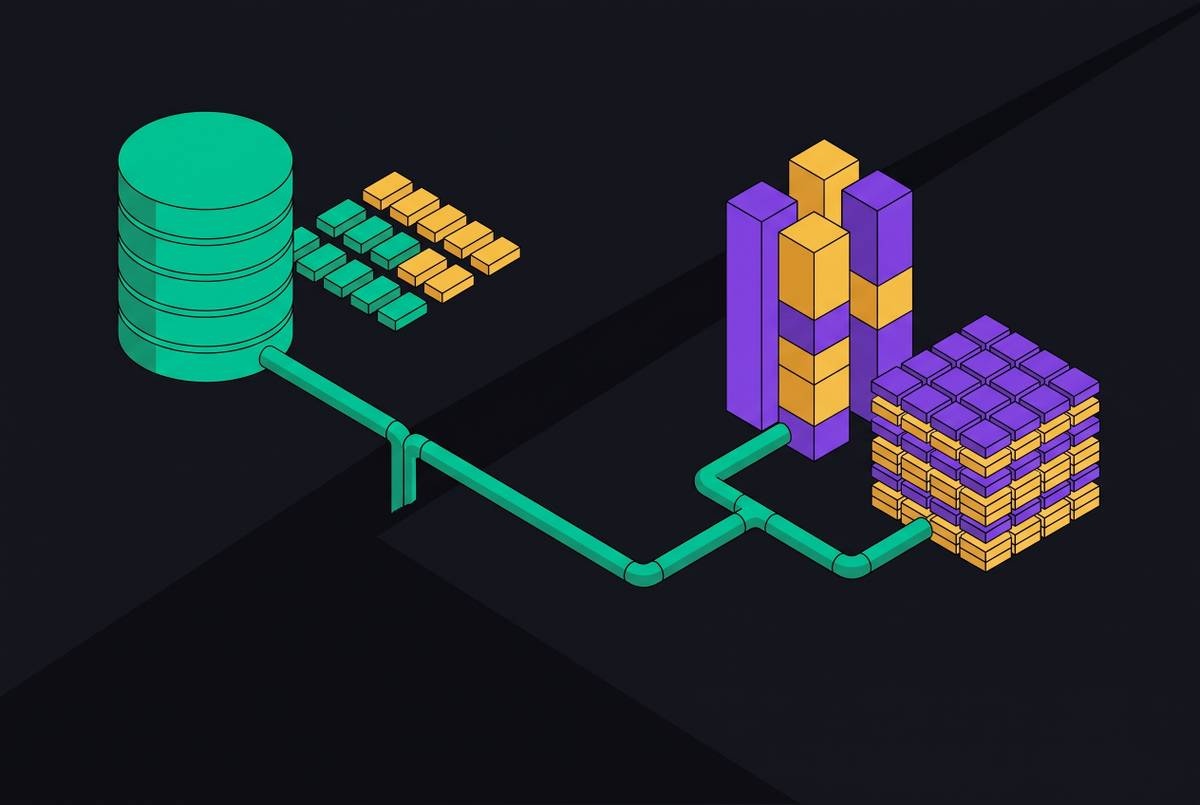
DuckDB answers this mismatch at the level of architecture, not raw throughput. It's an embedded, serverless, analytics-native engine: it runs in-process rather than as a separate service, requires no server to provision or manage, and is built specifically for complex analytical queries rather than the transactional record-keeping that Postgres and SQLite are optimized for. That inversion means an agent can get a complete analytical engine without the deployment and maintenance cost a separate service would carry.
Because DuckDB runs embedded, an agent can instantiate a complete analytical engine as a library call, run its queries, and discard the instance when the task ends. No persistent infrastructure needs provisioning. No session needs to be cleaned up afterward. No connection pool has to be shared with production traffic, because there's no connection pool at all in the traditional sense.
That cost profile is what makes a proposal described in the August 2026 DuckDB ecosystem newsletter, "To Every Agent Its Own Database," plausible. DuckDB, because it costs almost nothing to instantiate, can be.
The execution model reinforces the same point. The January 2026 DuckDB ecosystem newsletter documents a benchmark processing a full terabyte of Parquet files directly from S3 over HTTPS on a single node in well under a minute, which establishes a practical ceiling: a great deal of agent-scale analytical work never needs to leave the embedded model for distributed infrastructure.
Parquet and DuckDB: A Natural Pair for Governed Datasets
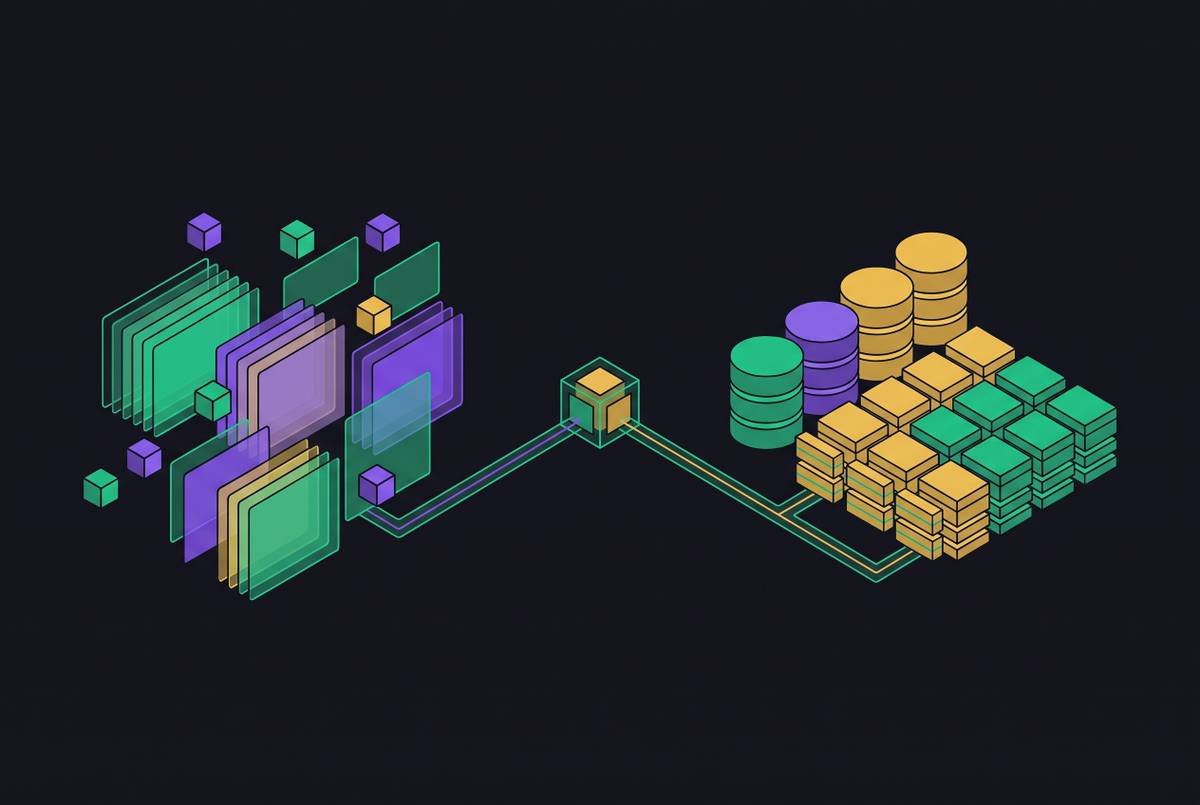
The right unit of data for an agent to consume is a pre-materialized, immutable Parquet dataset, not a live query fired against a production table. DuckDB is the engine that makes that format analytically complete on its own, without a loader, an ingestion pipeline, or a separate query service standing in front of it.
Parquet's columnar, compact structure supports exactly the scan patterns agents issue: aggregations, filters, projections across large column sets, without the row-by-row overhead that transactional formats carry. DuckDB reads Parquet natively from object storage, including S3, GCS through its S3-compatible API, and local filesystems, and it does so using glob patterns across partitioned datasets. An agent can query a governed dataset the moment it exists; no schema registration step has to happen first.
That same pattern scales past a single node. The January 2026 newsletter documents Quack-Cluster, an architecture that embeds a DuckDB instance per Ray worker to process Parquet and CSV files directly from S3, GCS, or local filesystems using glob patterns. The distributed version uses the same primitives as the single-node case, showing that the Parquet-native model isn't a workaround for small workloads but a pattern that holds as volume grows.
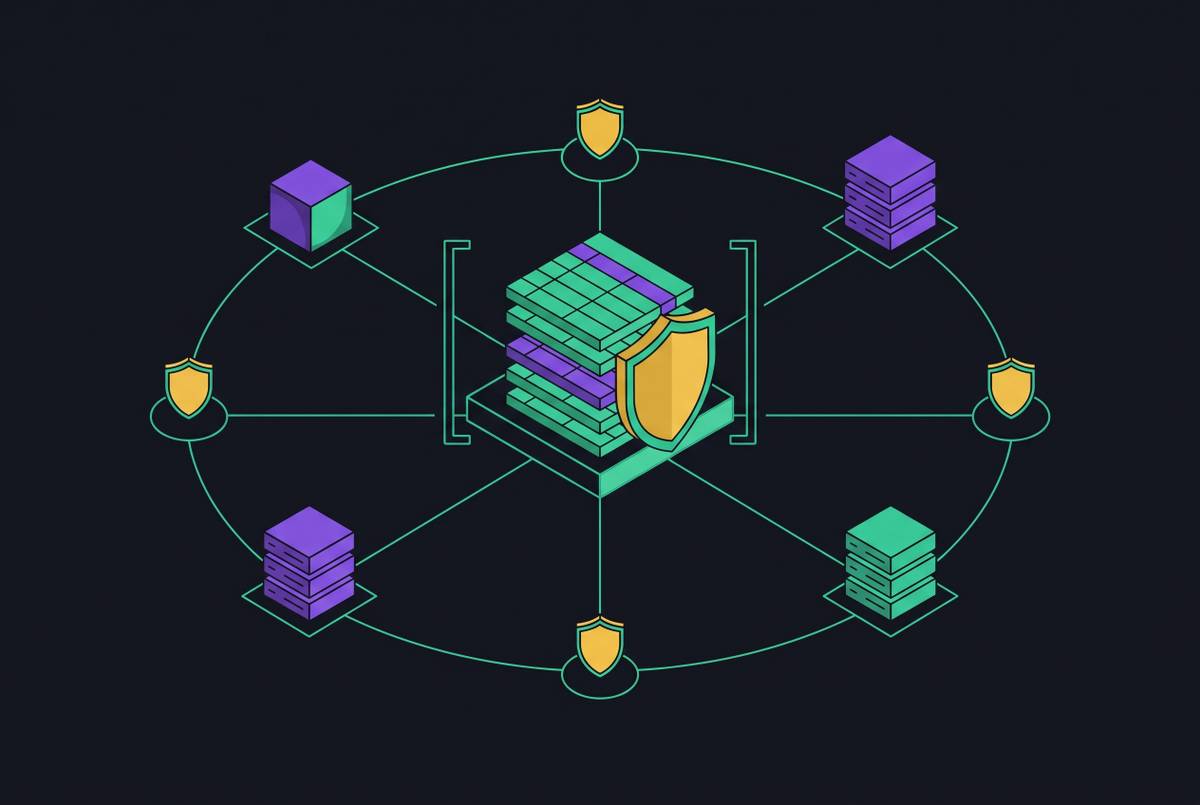
Immutability is the governance property that matters most once agents enter the picture. A Parquet snapshot cannot be mutated by a query running against it, so an agent operating on a governed dataset cannot corrupt the source data no matter what SQL it generates. The DuckDB team and MotherDuck push this further with DuckLake, an open table format (at v0.3 as of late 2025) that moves catalog and table metadata into a SQL database but keeps the actual table data as Parquet files in object storage. Separating the mutable catalog from the immutable data gives agents something concrete to trust: the data they're reading cannot shift underneath them mid-query, even as the catalog that describes it continues to change.
What was a best practice has, in the space of a year, become infrastructure policy. AWS's announcement on September 30, 2026 embeds DuckDB directly into Amazon Aurora PostgreSQL versions 17 and 18, enabling vectorized scans with predicate pushdown and column pruning against Apache Iceberg and Parquet data held in Amazon S3 and S3 Tables, accessed through the AWS Glue Data Catalog and Iceberg REST Catalog federation, with no separate data movement pipeline required. A cloud provider is building the Parquet-plus-DuckDB pattern into the database layer itself, and that signals this is no longer a workaround teams adopt out of necessity but a default architecture.
Agent Mode in the DuckDB CLI and Query Output
DuckDB's redesign for agents doesn't stop at execution.
The DuckDB team's October 2026 post on the feature names the problem directly: the default box renderer pads columns for human alignment, draws borders around the result, prints column types beneath column names, and truncates large results in a way a human eye can skim past without confusion. A model can't scroll through a terminal. It can't ask the renderer for more rows. It pays, in tokens, for every padding character it has to read whether or not that character carries information.
Agent mode activates automatically, with no configuration required from whoever built the agent, when three conditions hold at once: DuckDB detects a known agent environment variable (among them AI_AGENT, AGENT, CLAUDECODE, CODEX_CI, CODEX_SANDBOX, CODEX_THREAD_ID, CURSOR_AGENT, GEMINI_CLI, COPILOT_AGENT, COPILOT_CLI, and COPILOT_AGENT_SESSION_ID), stdout is not a terminal, and no explicit output format flag has been set. Large results are explicitly flagged as truncated. Errors report as JSON on stderr, so an agent can read structured fields like error_subtype and exception_message directly, instead of pattern-matching against human-readable error text.
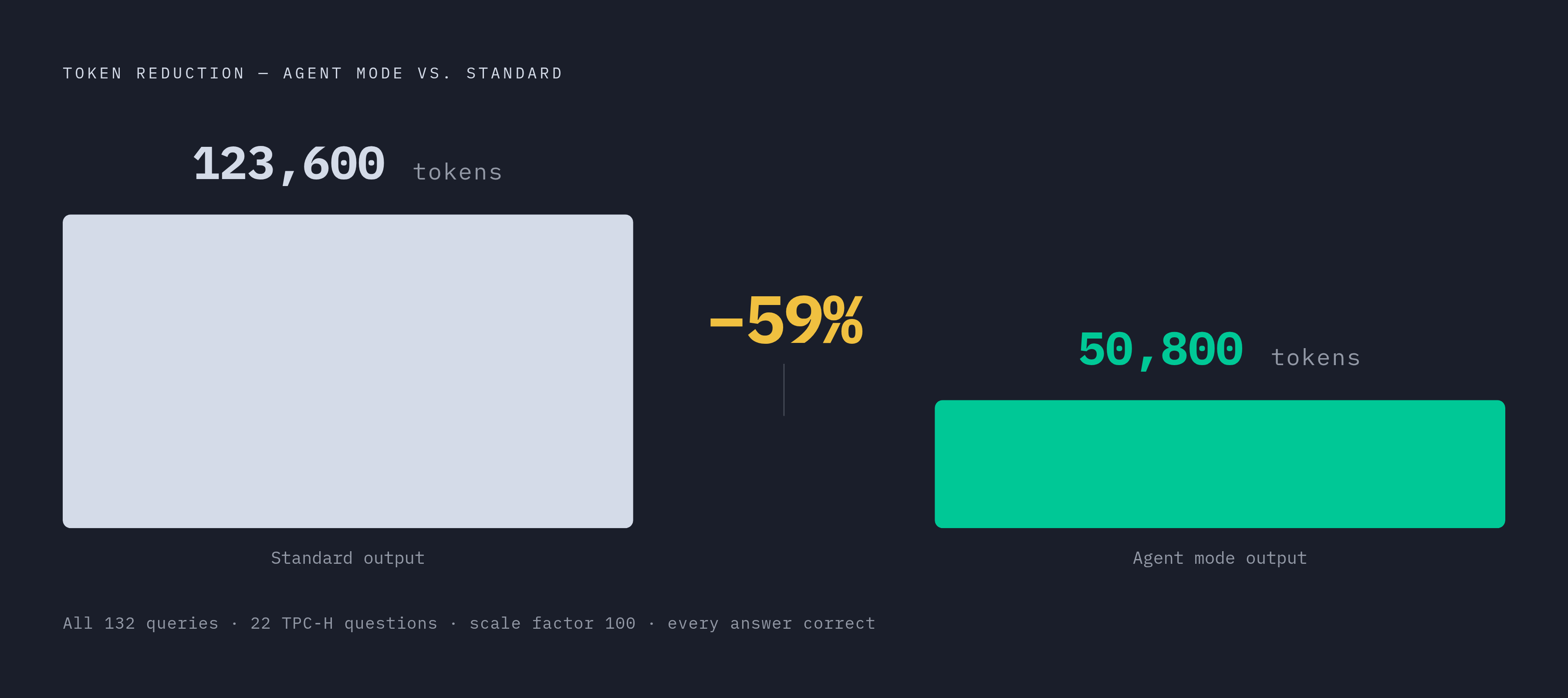
An experiment run against the 22 TPC-H benchmark questions at scale factor 100, phrased in plain English with no SQL supplied, showed DuckDB output read by the model drop from 123.6k tokens to 50.8k tokens across 132 runs, a 59% reduction, with every run producing the correct answer. You get reliability and reduced misreading of output, not a dramatic cut in total spend.
MCP as a Governed Interface for DuckDB
DuckDB's analytical power only becomes safe for agents to use once an interface controls which datasets an agent can discover, which queries it can run, and which definitions of its metrics it gets back. MCP, the Model Context Protocol, operationalizes that control.
The connection between the two is already built into DuckDB's distribution: the CLI connects to an MCP server through third-party packages such as mcp-server-motherduck, so agents can query data through DuckDB without a custom integration layer standing between them. MCP itself is an open standard for connecting AI models and agents to external tools and data sources through one consistent interface. The same MCP layer can serve Claude, Codex, ChatGPT, Cursor, Gemini, Grok, and agents running inside Slack, all without each one receiving its own separate interpretation of a company's metrics.
The protocol's July 28, 2026 specification revision made MCP stateless at the protocol layer. For agent workloads built around throwaway analytical contexts, that statelessness fits naturally: any node in the pool can serve a given request, because no request depends on a specific persistent session to make sense of it, and the infrastructure scales horizontally without coordination overhead.
The governance MCP enables is concrete. The MCP server is the point where "what the agent is allowed to see" gets enforced, rather than something left for the agent to self-regulate.
Transport and correctness are separate problems, and MCP solves only the first one. If an agent connects through MCP to ungoverned tables, it still produces confident wrong answers, because the protocol moves data and actions to the agent but doesn't make that data correct. What closes that gap is a semantic layer: metric definitions pre-calculated and published to the MCP server, so that what makes the connection trustworthy is the governance behind it, not just the fact that a connection exists.
Letting Agents Query Production Postgres Directly: An Architectural Decision
If you run on Supabase and Postgres, you don't follow the boundary between production queries and agent analytical traffic just as a best practice. It's a constraint the database enforces on its own as query volume grows, whether or not anyone designed for it.
Postgres is not a warehouse. Supabase's own roadmap acknowledges the limit: its Analytics Buckets, built on Apache Iceberg and AWS S3 Tables for columnar storage of analytical workloads while keeping compatibility with the Postgres interface, were in public alpha as of December 2025. When a cloud provider builds a separate analytical storage layer for a transactional database, you know the Postgres-native analytical boundary is a known limitation, not a hypothetical one.
Row Level Security helps with part of the problem. Supabase's RLS enforces access rules regardless of how a query arrives, so even a bug in application code won't return another user's data to an agent that wasn't supposed to see it. But RLS governs row access. It doesn't govern query cost or connection consumption, so it does nothing to stop an agent from issuing expensive scans that degrade the primary node, even if every row it touches is one it was authorized to read.
The standard production guidance, moving expensive reporting workloads to replicas, materialized views, or external analytical systems rather than adding compute to the primary node, anticipates exactly this problem. The governed Parquet-plus-DuckDB pattern resolves the boundary cleanly: agents query pre-materialized snapshots through DuckDB and never issue SQL against the production Postgres instance, regardless of what queries they generate, because the production database is structurally unreachable from the analytical path.
The metric consistency problem that governed datasets solve before agents surface it
When agents query raw tables directly, they have to reconstruct business logic from schema structure and the context of the query itself. Two agents, or two separate runs of the same agent, will reconstruct that logic differently, and the resulting metric drift stays invisible until the numbers disagree somewhere that matters, often a board meeting.
The drift starts as a definitional problem, then it becomes a technical one. If "MRR" means booked subscriptions on one dashboard and recognized revenue on another, the company never agreed on a shared definition to begin with. Agents don't create that disagreement, but they amplify it, because each one generates its own interpretation at query time rather than inheriting a definition someone already settled on.
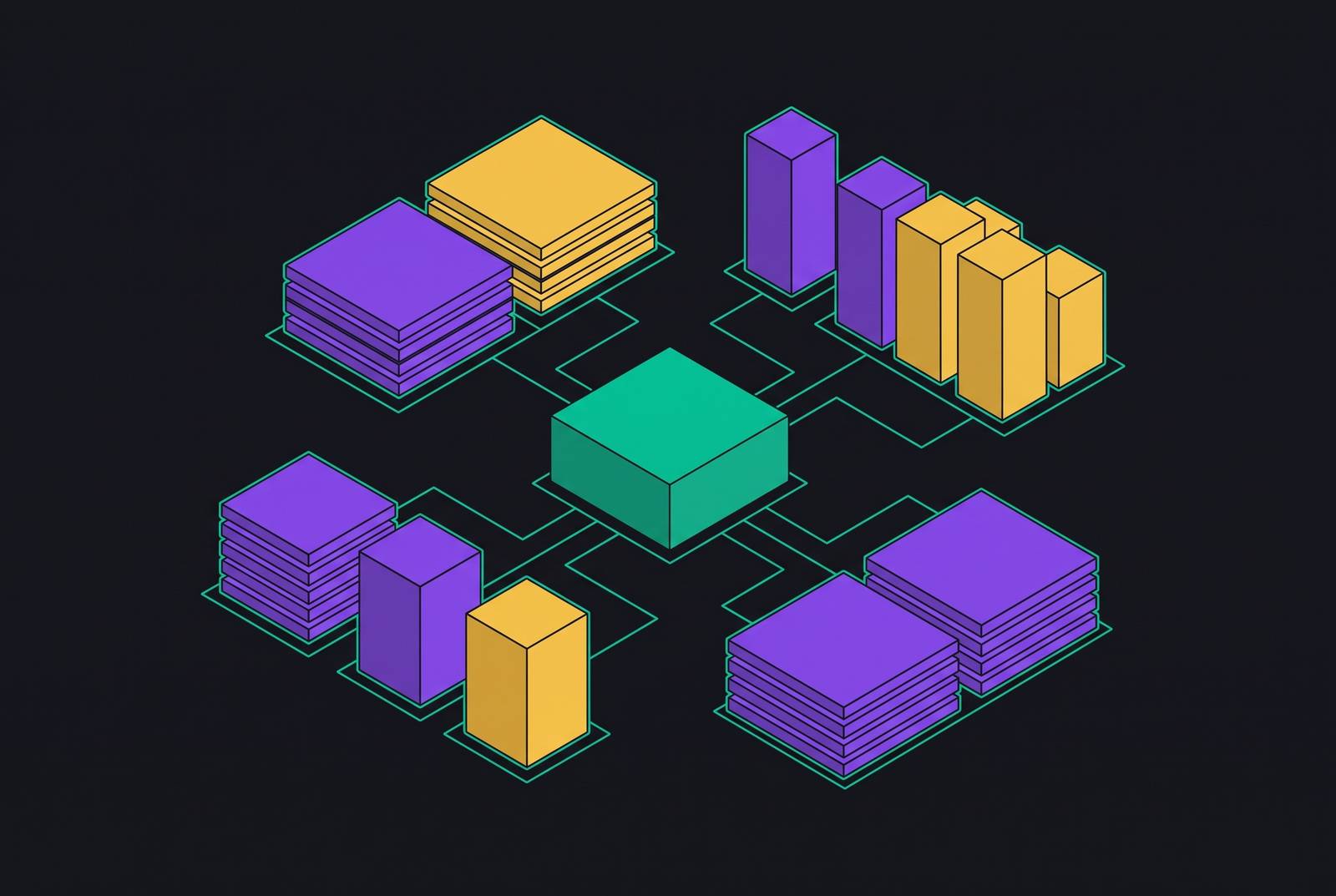
A pre-calculated, governed dataset solves this at the source: MRR gets computed once, from a single agreed definition, and published as a metric that both human dashboards and agents read from, rather than each party reconstructing the calculation independently. Decentralizing computation across per-agent instances solves for concurrency and rapid chaining of results, but it also decentralizes the risk of metric inconsistency: one agent operating on a stale Parquet snapshot and another working from a fresher export can produce two different answers to the same question, with neither agent aware that the other is working from different data.
For founders and operators, the organizational failure mode this prevents is specific: when sales, finance, and product each maintain their own version of ARR, the executive team spends its time arguing about whose number is right. Every metric on a CEO's dashboard should reconcile to one source, ARR from the billing system, cash from the bank, product usage from the analytical layer, and nothing else. Both the human teammates in that meeting and the AI agents generating reports for it need to consume from the same governed layer: dashboards, AI-generated reports, and agent queries should all read the same pre-calculated metrics, so that the definition of MRR, ARR, or active users stays fixed across every stakeholder reading it.
Agents never touch the production Postgres instance: the MCP server exposes only the governed dataset surface, and the production database stays structurally unreachable from any analytical or agent query path. That's not a setting someone can turn off by accident. Metrics get calculated ahead of time and pushed to where people already work, an inbox, a Slack channel, rather than pulled on demand by whoever happens to remember to check, so the same data layer serves the automated agent workflow and the human operator, with neither one needing to initiate the query.