Separating Analytical Workloads From Transactional Postgres
Mixing analytics with transactions strains Postgres, and here are four ways out.
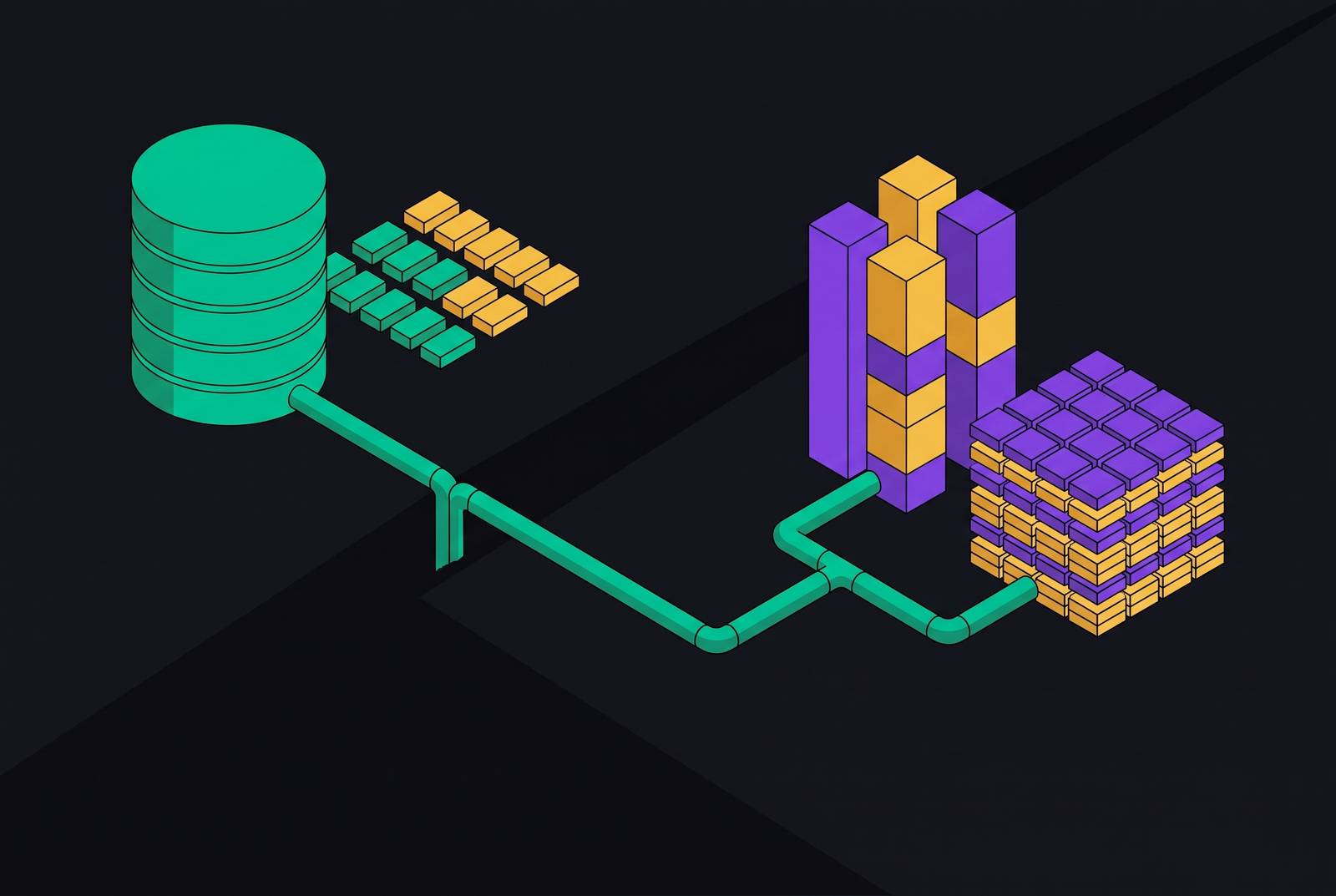
A single Postgres instance usually works fine for a long time. The trouble starts once analytical queries and transactional queries are asked to share the same engine at real scale, because the two workloads are optimized for opposite things at the storage and I/O level. No single engine does both of these well at the same time without compromise.
This tension is not new. As tables grew, a single analytical scan touching millions of rows could spike CPU and I/O enough to push payment confirmations from milliseconds to seconds, and the industry responded by pulling the two workloads apart into separate systems. That separation was a response to a measurable production problem, and the same problem recurs inside Postgres today for the same reason.
Running analytics directly against a production Postgres database produces three failure modes. When an analytical scan evicts hot transactional pages from shared buffers, that's buffer cache thrashing, and it means a monthly revenue report can make the checkout endpoint slower because both are competing for the same cache. AI and real-time workloads, vector search, high-frequency telemetry, agent-driven queries, generate I/O patterns that strain Postgres's row-store and MVCC model at scale, and they tend to intensify all three failure modes at once.
None of this means Postgres is slow. Tuning one engine to serve both eventually runs out of room, and the pressure that builds comes from the architecture itself. It also builds quietly: dashboards stay light for a long stretch, but then retention windows grow and aggregations get heavier.
How the "Postgres for everything" movement worsens the problem
The recent instinct to run everything on Postgres makes sense at small scale, and it speeds up the exact moment when workload contention turns critical. Standard Postgres strains under heavy aggregations, wide fact tables, and high-concurrency analytical queries, because the same internal architecture that makes it dependable for single-row lookups turns into a bottleneck the moment the executor has to scan millions of records for a user-facing dashboard.
The consolidation pattern rarely arrives as a deliberate architectural decision. AI agents compound the same dynamic from a different angle: agents issue many database calls per interaction in a chatty pattern that looks nothing like the predictable request-response cycle of a traditional web application, and every vector insert along the way writes a wide row, updates indexes, and generates WAL, adding write pressure at the same moment analytical read pressure is climbing.
What makes this dangerous is timing. Dashboards get heavier, retention windows stretch, analytical scans grow, and aggregations become expensive, and contention reaches into production traffic by the time that happens. A team can be well into this pattern without any single decision that put them there.
Where read replicas stop working
Read replicas are a reasonable first move; they genuinely reduce contention on the primary while leaving the underlying engine unchanged. Running complex analytical queries against a replica and reserving the primary for create, update, and delete operations separates the two workloads enough to buy real breathing room, and that's a legitimate step for a team that has outgrown a single instance. Adding replicas does nothing for write-side bottlenecks like WAL bloat or autovacuum starvation on the primary, and it does not make analytical queries themselves faster. It shifts contention to a different part of the system.
Supabase-specific details narrow the room to maneuver further than many teams expect. Billing treats a replica as a full mirror of the primary's resource footprint, compute, disk, IOPS, throughput, and IPv4, and that cost sits entirely outside the spend cap. Two settings govern this behavior, max_standby_streaming_delay, which defaults to 30 seconds, and max_standby_archive_delay, and neither is a substitute for a different storage engine.
None of this makes replicas the wrong choice early on. For a team whose analytical queries are still light, a replica is a legitimate trade-off that buys time and keeps the architecture simple. The point to move past it arrives when analytical scans are large enough to trigger query cancellations, when replication lag makes the data too stale to trust, or when the gap between row-store scanning and columnar scanning starts costing real time on a regular basis. A replica postpones the architectural decision. It does not answer it.
The architectural options that separate the workloads
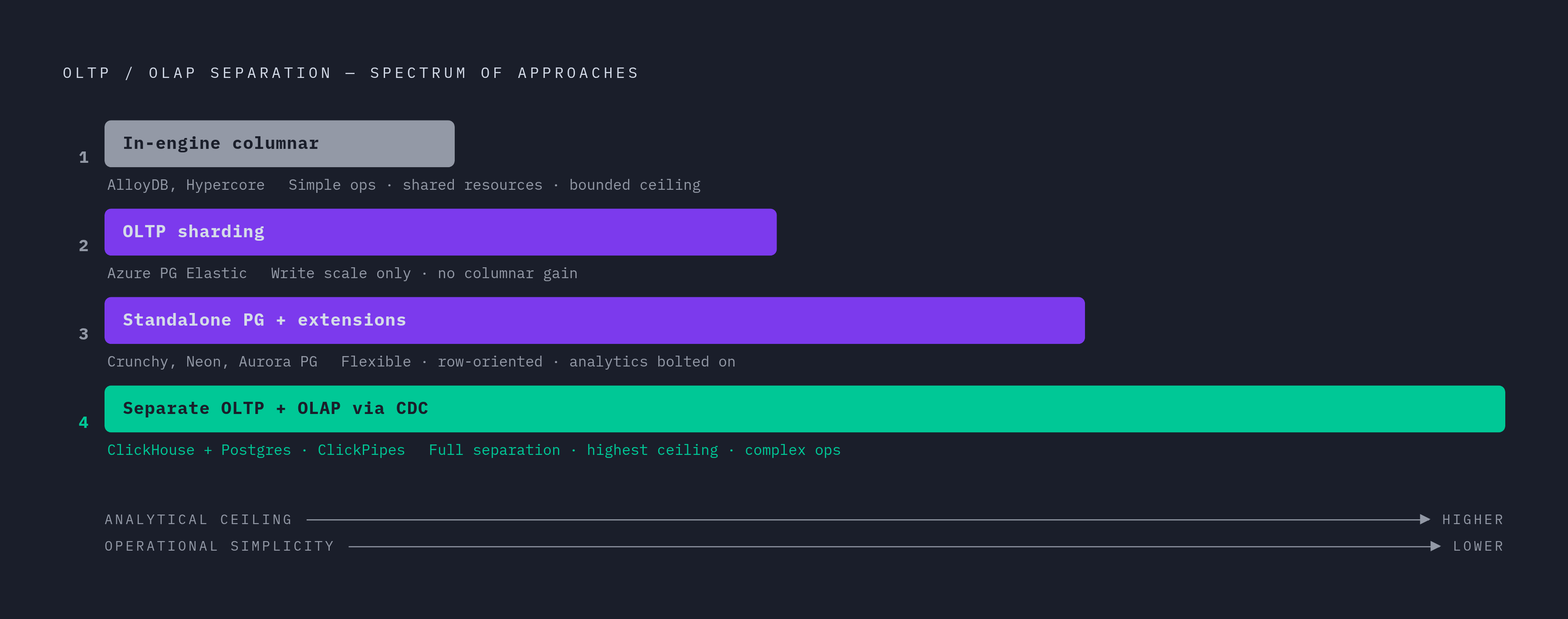
Once a team accepts that the engine itself needs to change for analytical workloads, the managed Postgres landscape in 2026 offers several distinct approaches, and the right choice depends on what a team is already committed to.
One approach adds columnar acceleration inside the Postgres process itself. Google AlloyDB combines a row store with an optional column store for memory and storage caching, so it fits teams already committed to GCP who want in-engine columnar acceleration without rewriting their application, and it offers a 30-day free trial. Tiger Cloud takes a similar hybrid approach through TimescaleDB Hypercore, combining row and column storage in one engine, and fits teams that want a single PostgreSQL engine handling both transactional data and predefined time-series rollups through TimescaleDB hypertables and lifecycle policies, with a 30-day trial on its Performance plan. Both keep operational complexity low by staying inside one engine, but the analytical ceiling is lower than a dedicated columnar system, because both workloads still share resources at the process level.
A second approach scales the OLTP layer horizontally through sharding. Azure Database for PostgreSQL with Elastic Clusters uses a distributed sharding architecture, so it fits teams staying within Azure whose analytics needs are limited to lighter operational reporting, backed by an SLA of up to 99.99% with zone-redundant high availability. This addresses write and OLTP scale directly, but the column-store problem that heavy analytics eventually runs into remains unsolved.
A third approach is standalone managed Postgres with broad extension flexibility. Crunchy Bridge offers row-oriented PostgreSQL with superuser access and wide extension support, with optional analytics available through Crunchy Data Warehouse clusters, a dedicated cluster type available on AWS through Crunchy Bridge, and a 99.95% SLA for eligible high-availability configurations. Neon focuses on serverless developer workflows at lower scale, with storage and compute separated, and fits teams that want database branching, isolated test environments, and scale-to-zero economics, backed by a 99.95% SLA on its Scale plan and a free plan for smaller use. Amazon Aurora PostgreSQL keeps a row-oriented engine with Optimized Reads and pairs it with a separate Redshift target for zero-ETL analytics, fitting AWS-native organizations, with an SLA of up to 99.99% in applicable Multi-AZ configurations.
The fourth approach splits OLTP and OLAP into separate engines connected by change data capture, and it represents the industry's clearest answer to the question of whether one engine can genuinely serve both workloads. ClickHouse's managed Postgres offering pairs Postgres as the OLTP system of record with a separate ClickHouse service, where ClickPipes continuously replicates Postgres data into ClickHouse and pg_clickhouse pushes supported analytical queries through the Postgres interface into the columnar engine; this fits teams whose high-concurrency analytics genuinely need a dedicated columnar system. This is not a single engine doing both jobs. The premise that a single engine can genuinely serve both OLTP and OLAP has not held up in practice, because storage format, I/O pattern, memory allocation, concurrency control, and latency targets pull in different directions for each workload, and composed architectures are the industry's response to that reality.
Pre-modeling analytical data into governed datasets as the right extension of Postgres
The instinct to move analytics "somewhere else" often brings in more complexity than the problem requires. A full data warehouse connected by ETL pipelines solves the resource contention between analytical and transactional workloads, but it introduces cost, latency, and operational overhead that a small team usually cannot absorb alongside everything else it's building. The more proportionate move is to model analytical data ahead of time and expose it from a governed layer that Postgres still feeds. In practice, pre-modeling means calculating metrics and aggregations in advance, storing the results in read-optimized formats such as materialized views or Parquet datasets, and separating the analytical read path from the transactional write path, without replicating the entire schema or standing up a separate warehouse system.
Xata's experience illustrates what this looks like in practice. A small team centralized identity data, product usage, billing, and PostHog events into a Postgres data warehouse using materialized views, pg_cron, and database branches, with no dedicated OLAP system running. The warehouse made that kind of question answerable directly. The design constraint that made it safe was explicit: analytics never run against production, and a separate Postgres instance receives the ingested and modeled data, leaving the transactional database untouched.
Pre-modeled datasets solve a second problem beyond performance: the semantic one. A metric calculated on demand, by whoever happens to run the query, produces different numbers depending on who's running it, what filters they chose, and what date boundaries or join conditions they assumed. Calculating that metric once, with one definition, in one governed place, and sharing it everywhere removes the argument over which number is correct before it starts. For a Supabase team, Postgres is already the authoritative source of the data in question, so the analytical layer should extend outward from that authority rather than get extracted into a disconnected system that drifts from it over time. Supabase's own platform direction follows this logic: Supabase Pipelines is built to move data into infrastructure designed for analytical work, with a recommended pattern of keeping recent operational data in Postgres and streaming historical data out to an analytical destination. Postgres remains the transactional home and source of truth in this arrangement. It stops being asked to serve as the query engine for historical aggregations it was never built to run.
Why AI agents make governed data separation non-negotiable
Everything so far makes the case for separation on performance grounds. AI agents change the stakes. Once agents are querying a database directly, letting analytical workloads touch production stops being a question of how fast a dashboard loads, because now security and correctness are on the line. Agents can be manipulated into executing SQL that exposes sensitive data or modifies protected records, and the access control that has traditionally lived in the application layer does not hold up when the SQL being run is constructed dynamically by an agent and cannot be reviewed or tested for safety in advance the way a hand-written query can.
The specific risk here is that an agent can be tricked into using its own elevated privileges to access data the requester should not be able to reach. The fix is to define read and write access explicitly rather than by default: most agents need only read access, and the systems and databases each agent can reach should be enforced technically.
Model Context Protocol has become the standard interface layer connecting AI agents to external tools, systems, and data sources, but its own design choices make governed data more important, not less. The MCP specification released July 28, 2026 introduced a stateless protocol core. Transport-level session management is gone, any request can land on any server instance, and deployments can run behind plain round-robin load balancers instead of requiring sticky sessions and shared session stores. That architectural shift makes MCP easier to deploy at scale, but it says nothing about what data the agent is allowed to see once connected. MCP does not replace the need for clean, governed data. An agent connected to ungoverned tables still produces confident, wrong answers with total fluency, and because agents query far more aggressively than a human analyst would, they surface every naming inconsistency, every permission gap, and every conflicting metric definition faster than a person does.
The sound architectural answer keeps agents off the production OLTP database entirely and gives them a governed, read-only analytical surface instead. Agents query a read replica, a materialized analytical copy, or a columnar engine, reached through an MCP server configured with row-level scoping and read-only credentials that limit access to a defined scope. The compliance stakes raise the cost of getting this wrong: if integration middleware caches or stores third-party data along the way, SOC 2, HIPAA, and GDPR liabilities attach to that middleware immediately, and a governed dataset with explicit scope is the only surface that avoids inheriting them.
What a governed analytical layer unlocks for data-function-less teams
A governed analytical layer defends against performance degradation and agent misbehavior, and it is the infrastructure that lets a small team operate on numbers everyone trusts without hiring a dedicated data function to produce them. Most startups already have the data they need; it's scattered across a product database, Stripe, a CRM, and a handful of spreadsheets, and a warehouse-style layer solves that discovery and consolidation problem before it solves anything about query speed. Pushing pre-calculated metrics to where people already work, a chat tool, email, a weekly summary, removes the dependency on someone remembering to go check a dashboard.
AI analyst agents extend this further once the underlying data can be trusted. The wall most teams hit here is a data limitation: teams evaluating AI analyst tools run into ungoverned, inconsistent data before they ever run into something the agent genuinely cannot do, and a governed, pre-modeled data layer is what clears that wall.
The practical path follows the scale of the problem. Agents never touch it directly. At every stage of that progression, Postgres stays home, and the analytical layer extends from it.