What the Model Context Protocol Does for Data Infrastructure
MCP converts fragmented data integrations into a unified access layer for AI agents and humans.
The Model Context Protocol turns data infrastructure from a web of point integrations into a shared access layer, but that layer is trustworthy only when its metrics and permissions are governed. For API-first and agent-first teams, the useful headless analytics pattern is a governed backend that serves agents and human interfaces from the same definitions. Dreambase applies this pattern to Supabase through pre-calculated analytical datasets exposed through a single MCP server.
Why data infrastructure needed a new connection model before AI agents arrived
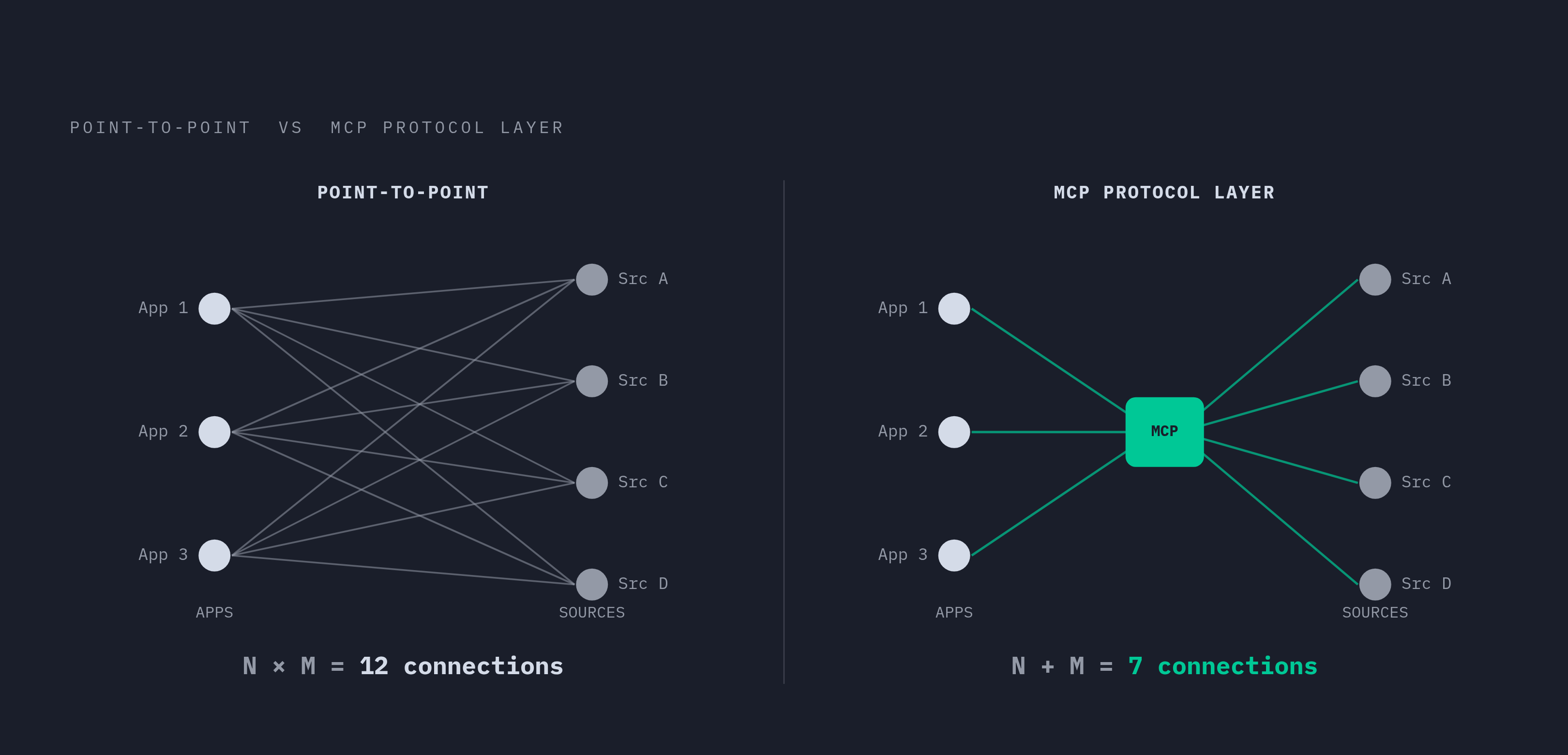
A custom connection does more than move a request between two systems. It has its own approach to authentication, its own data format, and its own error handling. When every application needs its own connector to every source, those differences add up to an N×M integration problem.
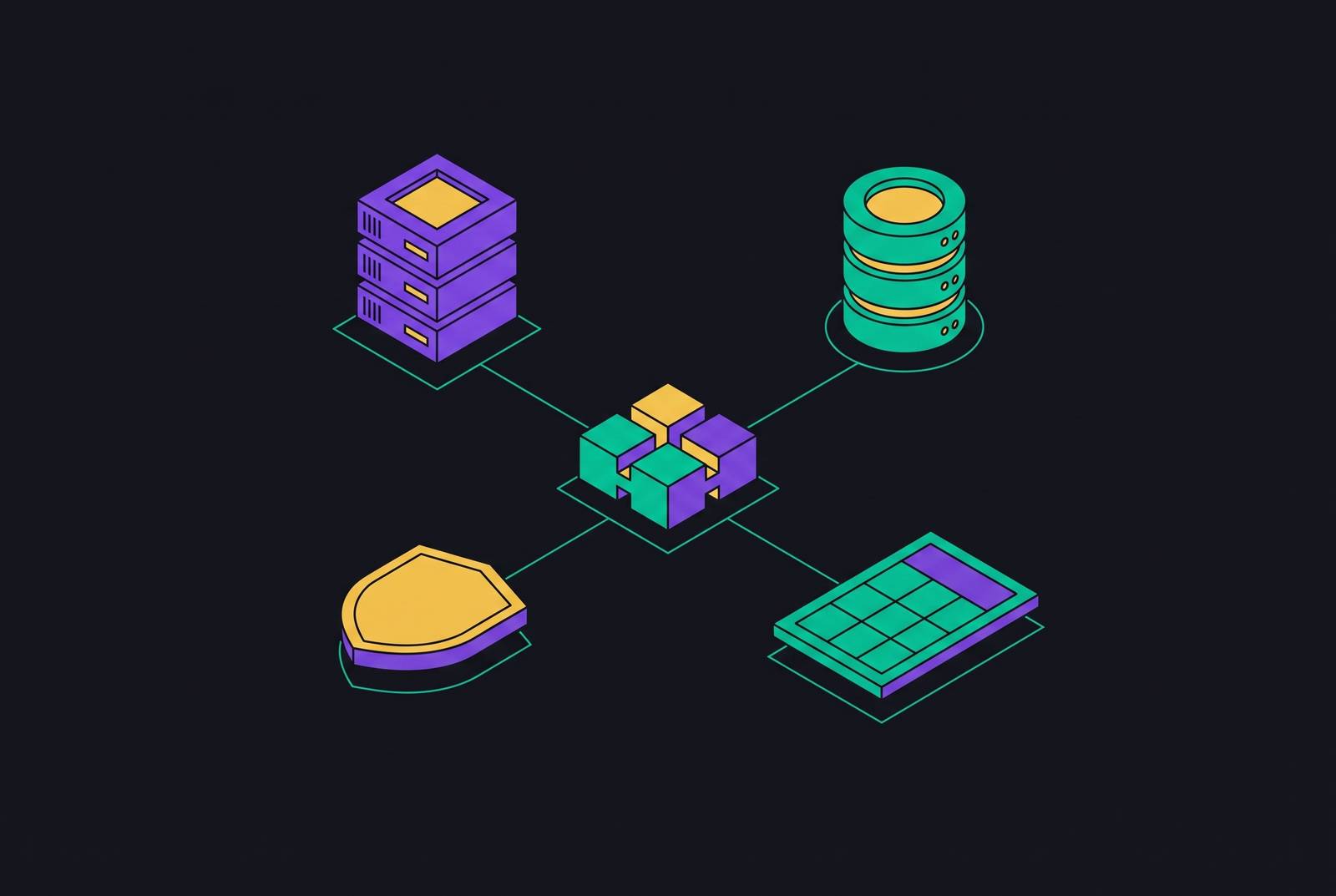
This problem was worse in data infrastructure because production databases, warehouses, semantic layers, and BI tools each needed another connection. AI agents inherited that fragmentation, with each agent potentially needing its own connector to each component. MCP changes the integration count from N×M to N+M by giving applications and sources a common protocol. Dreambase illustrates the consolidation for Supabase teams by serving pre-modeled datasets through one governed MCP server.
What MCP actually is and how its three-layer architecture works
MCP divides the work of the connection among three roles: Host, Client, and Server. The Host is the AI application the user interacts with, such as Claude, ChatGPT, Cursor, or a custom agent. The Client lives inside that host, manages protocol negotiation, and routes requests to the appropriate server. The Server exposes capabilities through a standard interface that the application can discover and use. These roles separate the user-facing application from the systems that supply its data and actions.
For data infrastructure, the server’s three primitives have distinct analytical purposes. Tools take actions such as running a query, while Resources give the agent context such as schemas and governed datasets. Prompts supply reusable templates that can codify repeatable analytical workflows. Together, they let a server expose not just a way to retrieve data, but the context and workflow needed to use it. In a governed implementation such as Dreambase, that interface can give agents standardized access to metrics without directing them into production databases.
The APIs underneath those capabilities perform the work, while MCP supplies a standard way for an AI application to discover and invoke them. A single request can therefore draw on multiple servers and combine their results into one response. The infrastructure benefit is a common contract across existing systems.
How the protocol has matured from a developer experiment into an enterprise-grade standard
Anthropic introduced MCP in November 2024 and donated it to the Agentic AI Foundation under the Linux Foundation in December 2025. That move put the protocol under vendor-neutral, community governance and took it out of the hands of one application provider. Support across Claude, ChatGPT, Gemini, Microsoft Copilot, and Cursor has made MCP a shared integration surface across competing platforms. Support is not uniform, however, with ChatGPT requiring Developer Mode on paid plans and Gemini and Microsoft Copilot offering narrower or more constrained support than Claude and Cursor.
The 2026-07-28 specification addressed a different barrier to enterprise use by making MCP stateless at the protocol layer. With protocol-level sessions retired, requests can reach any server instance behind a plain round-robin load balancer. For data teams, this makes horizontal scaling easier and leaves less to depend on where a session sits. The change makes the protocol better suited to shared services handling concurrent agent traffic rather than only a client connected to a particular server.
The same revision formalized an extensions framework that includes Tasks, MCP Apps, and Enterprise Managed Authorization. It also hardened authorization through RFC 9207 issuer validation and deprecated Dynamic Client Registration in favor of Client ID Metadata Documents. Dynamic Client Registration is still available for backwards compatibility, with a formal deprecation policy that keeps it in place for a twelve-month minimum window. These changes make the protocol more manageable as infrastructure, although they do not replace the access-control decisions each deployment must make.
Why statelessness at the protocol layer changes what data infrastructure teams can build
Before the 2026-07-28 revision, a client and server maintained a protocol session. Preserving that context across instances required shared storage and complicated horizontal scaling. The revision retires the initialize/initialized handshake and Mcp-Session-Id header, with each request carrying its protocol version, client identity, and capabilities in metadata. An MCP server in front of governed analytical data can therefore scale like a REST API, without session affinity or shared storage for protocol context.
For platforms such as Dreambase, stateless MCP provides the operational model for concurrent access to modeled datasets without tying each agent to a server instance. It does not, however, make the underlying database unlimited. Agents querying production Postgres directly can exhaust connection pools, so adding MCP server instances cannot by itself remove that bottleneck. A governed analytical copy keeps agent query traffic away from production, and statelessness lets the access layer scale on its own.
The revised protocol also handles interaction without requiring held-open streams. Multi Round-Trip Request, or MRTR, supports cases where a tool needs a confirmation or missing parameter during a call. Method and tool names travel in the Mcp-Method and Mcp-Name HTTP headers, allowing gateways, rate limiters, and WAFs to route and authorize without parsing JSON bodies. These changes simplify request handling while leaving responsibility for the systems those requests reach in place.
The semantic layer as the thing that makes MCP-accessible data trustworthy, not just accessible
Standardized access does not establish what a metric means. If three analysts maintain different definitions of a conversion event, an agent cannot resolve the disagreement simply by querying faster. It needs a single human-established definition against which to ask its question. Without that definition, MCP can pass different readings of the same data to more consumers. Connectivity solves the problem of reaching data, while a semantic layer solves the separate problem of agreeing on its meaning.
A governed analytical layer makes that agreement part of the infrastructure. Headless BI platforms that support MCP demonstrate the pattern by letting agents query metrics through the same layer dashboards use. Claude and a dashboard can then answer from identical definitions instead of constructing separate SQL for the same business question. This removes the need for an agent to invent metric logic, though it does not make every possible interpretation of a result correct. The boundary is precise because the infrastructure owns the definition and the agent consumes it.
Pre-calculated metrics stored in governed Parquet datasets and queried through DuckDB make Dreambase an example of this separation. Its MCP server exposes the analytical layer rather than asking agents to construct metric definitions against production tables. For a team adding usage analytics to an agent without a prebuilt dashboard UI, the important choice is therefore the metric backend. An MCP Resource should carry a governed metric.
What the governance gap looks like in practice and why access control cannot be bolted on after deployment
The U.S. National Security Agency stated in a May 2026 report that MCP’s “rapid adoption has outpaced the development of appropriate security safeguards”. The warning identifies a gap between connecting an agent and controlling what that agent can do. Identity, audit, and access-control gaps can stall an agentic deployment even when its tools work. A consistent metric definition does not answer which user may access it or which actions an agent may perform. Semantic governance and access governance are separate requirements of the same layer.
The emerging control model starts with an enforced tool allowlist for each agent. OAuth 2.1-based identity binding lets agents inherit scoped user permissions. A centralized MCP gateway gives security teams one inventory, while mandatory human-in-the-loop approval constrains destructive or irreversible actions. The protocol’s authorization hardening supports this design, but it does not supply the policy itself. Teams still have to establish the boundary between an available capability and an authorized action.
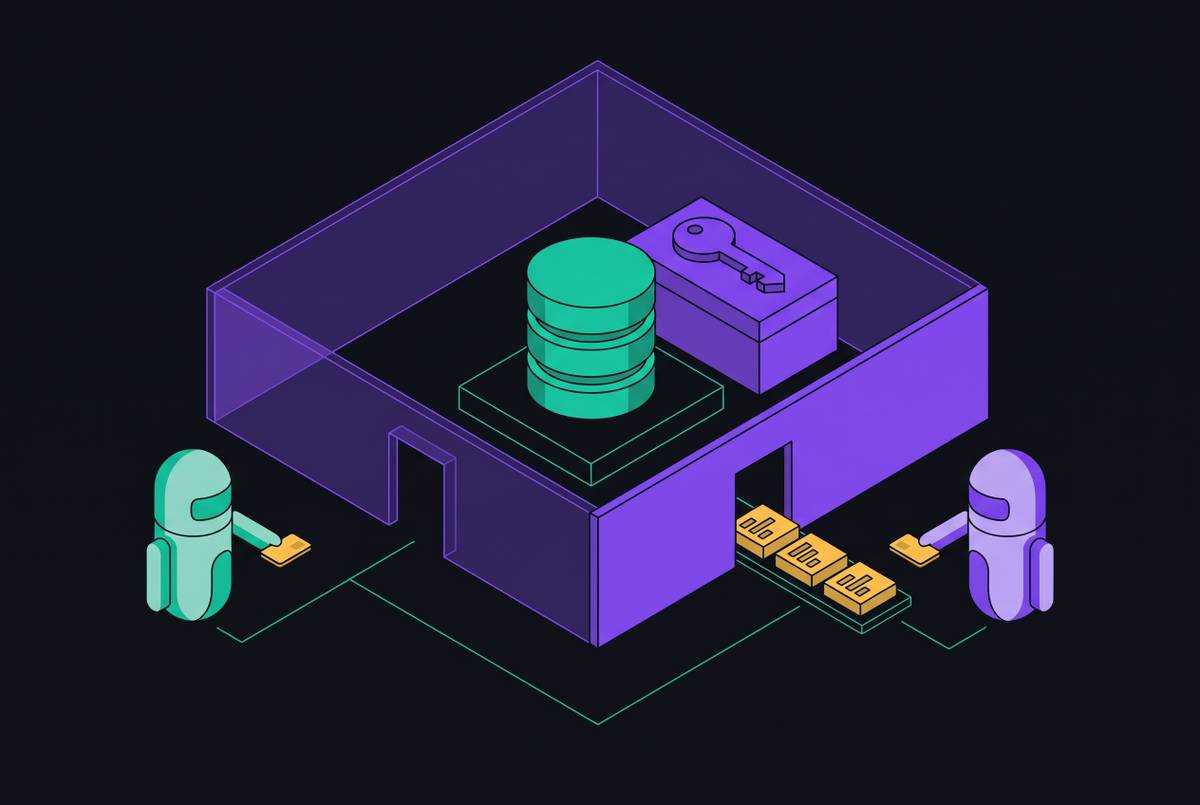
For Supabase and Postgres teams, that boundary has immediate consequences. Direct agent queries against production risk both connection-pool exhaustion and bypassing row-level security. The correct analytical pattern is an MCP server that queries a governed copy, with agents kept away from the production instance. This keeps the operational database safe, but the analytical layer still needs its own scoped access rules. Governance needs to be built into the data path because that path sets which permissions and resources an agent can reach.
How MCP is reorganizing data infrastructure around a single governed access layer rather than point integrations
Informatica, now a Salesforce subsidiary, announced native MCP support across its entire Intelligent Data Management Cloud at Informatica World 2026. Its MCP servers are live or in preview across AWS, Microsoft Foundry, Databricks Agent Bricks, Snowflake Cortex AI, and Salesforce Agentforce.
Salesforce announced Headless 360 at TrailblazerDX on April 15, 2026, with more than 60 new MCP tools and 30+ preconfigured coding skills. It presents Salesforce capabilities as APIs, MCP tools, or CLI commands accessible to humans and agents without a browser. Salesforce reported millions of MCP calls processed since launch by late May 2026. ZoomInfo’s GTM.AI, generally available June 1, 2026, follows a related pattern as a headless GTM context layer that exposes its graph through MCP.
Databricks makes the shared-definition principle explicit through Unity Catalog metric views authored in SQL DDL or YAML. Its Genie agent and dashboards answer from those definitions, while outside agents reach Genie through the generally available Genie One MCP server.
What analytics infrastructure fits a Supabase team without a dedicated data function
Supabase’s own MCP server is useful, but pointing it at production creates the exposure a governed analytical architecture is designed to avoid. It lets an agent run SQL, design tables, deploy Edge Functions, and read logs in a Supabase project. Those operational capabilities serve a different purpose from access to agreed business metrics. The distinction matters for a small team because a convenient route into its database is not necessarily a suitable analytics backend.
For analytics, the alternative is an independent, stateless MCP server exposing pre-modeled datasets queried through DuckDB against governed Parquet files. Dreambase implements this pattern by extending a Supabase project with pre-calculated metrics and a single MCP access surface. It requires no ETL, schema changes, new infrastructure, or dedicated data team.
For API-first and agent-first teams, the selection criteria follow from that distinction. The backend needs reusable metric definitions, programmatic consumption independent of a fixed frontend, scoped access, and separation from production query traffic. Supabase’s Agent Skills for Postgres Best Practices have rules for safe SQL that cover connection management, Row Level Security, and query performance, among other areas. A governed analytical layer applies the same discipline to the data agents consume. The founder benefit is one infrastructure layer that supplies board-ready numbers for humans and safe, reliable context for agents.