The Governance Checklist for Headless Analytics Backends When Your Frontend Is a First-Party Build
A custom analytics frontend inherits permissions, definitions, and query limits.

For API-first and agent-first teams building their own frontend, the best-fit headless analytics backend separates presentation from governed metrics without exposing an unrestricted database query surface. This governance checklist defines the controls that make that architecture trustworthy, including registered definitions, isolated analytical data, pre-query permissions, bounded requests, and auditable answers. A custom interface transfers those obligations to the builder.
What headless BI actually means and what it transfers to the first-party builder
Traditional BI keeps the data, logic, presentation, and delivery in one tool. Metric definitions live in that interface, and the vendor takes care of the permission model, definition registry, and query boundary. Headless BI separates analytics logic from presentation. Its metric definitions, business rules, SQL, and data models can serve dashboards, Slack bots, AI agents, and spreadsheets through the same backend.
That separation responds to three forces in 2026. Dashboards are no longer the default interface, teams with composable stacks must sort out differences when specialized tools calculate the same metric in different ways, and agents need programmatic access. Once a team builds its own frontend, it takes charge of the query layer, access rules, and accuracy contract that were part of the packaged interface. Governance complexity has moved from the vendor’s hands into the builder’s codebase.
The four layers of a headless analytics backend and where governance breaks at each one
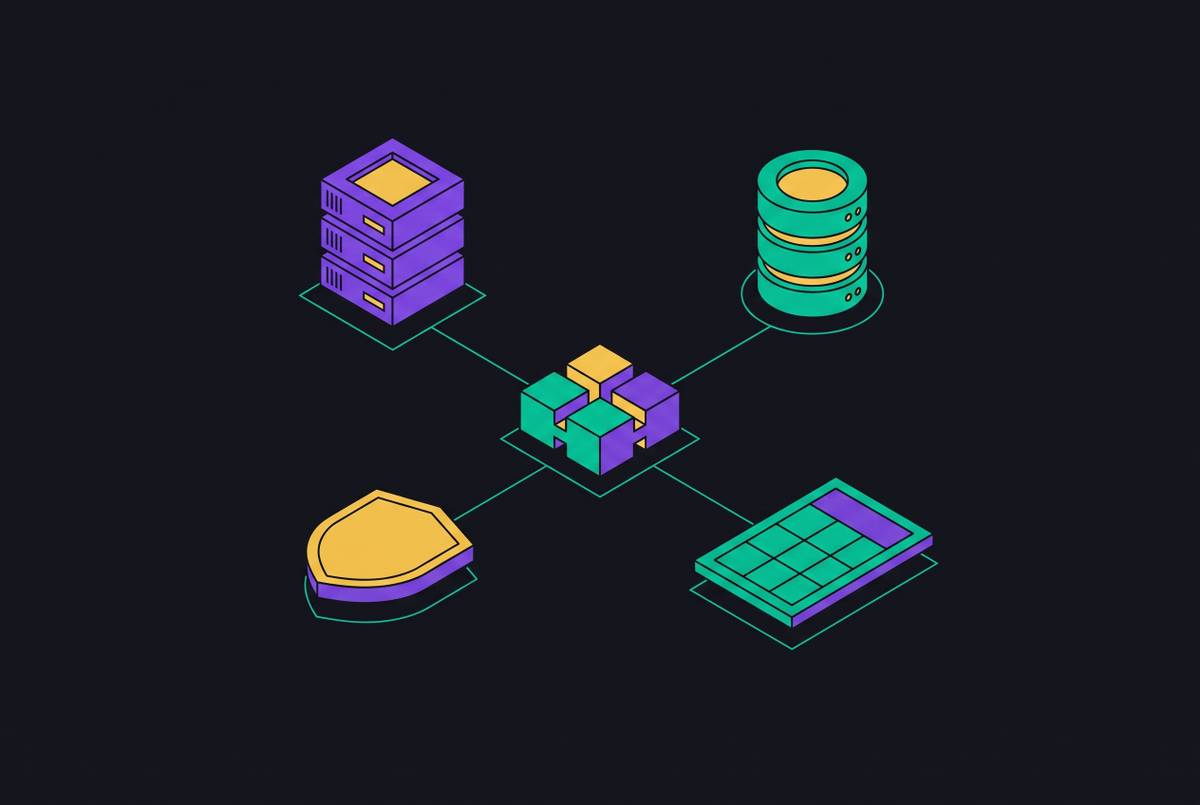
The Data Substrate consists of verified, permissioned, refreshable data with documented provenance. Without that provenance, a consumer cannot establish which refresh cycle or permission boundary produced a number. The Reasoning Layer supplies semantic schemas, governed context, and metric definitions. Its defensibility comes from business logic. Without a shared registry, three analysts can write individually correct queries for “net sales” with different exclusions and produce conflicting answers.
The Delivery Layer makes that intelligence reachable through an API or MCP endpoint. Serving and enforcing are different jobs. A governed semantic layer can still have an ungoverned front door if its endpoint lacks a permission model. Whether a definition is authoritative says nothing about whether a particular consumer may request it.
The Decision Layer connects intelligence to action through an owner and an outcome. Without an owner, no one has a clear duty to sort out conflicting answers from the same backend. Each failure therefore has a distinct location. Missing provenance belongs to the substrate, inconsistent meaning to reasoning, unauthorized access to delivery, and unresolved accountability to decisions. This map also exposes the next design question, which is when the delivery layer checks permission.
Why agent access makes ungoverned layers a production risk, not just a data quality problem
Agents turn definition drift into repeated, automated inconsistency without a human checkpoint. They need a human to reconcile three definitions of “conversion” before they ask their question. Direct access to production Postgres adds a separate risk because agent requests can use up the connection pool. Those requests can also work with row-level security policies in ways that differ from dashboard queries, revealing problems at the permission boundary that an access configuration built for humans did not cover.
Scaling the protocol server does not resolve either problem. MCP’s July 2026 stateless revision removed protocol-level session affinity, so it is easy to put multiple server instances behind a plain round-robin load balancer. The database retains its own capacity limit. More MCP instances make it easier for the access layer to scale horizontally, but the production database’s connection pool stays the same size.
The safe approach is to put a governed analytical copy behind the MCP server. Pre-calculated datasets, including governed Parquet files queryable through DuckDB, provide context without production connection-pool pressure. Agents discover available datasets and request them by name through Resources and Tools. No agent query reaches the production instance. That boundary separates the work of preparing trusted analytical data from the unpredictable volume of requests consuming it.
Checklist item 1 — Defining and registering every metric before the first query runs
Revenue leaves the calculation, aggregation, exclusions, grain, and filter set unresolved. A first-party builder must specify which columns contribute, whether the result is per day, per user, or per order, and what is included or excluded and why. Otherwise, every consumer can supply its own interpretation. Permissions would then control access to an undefined thing.
Once the definition is registered, it is available wherever someone requests a number. A dashboard configuration, notebook comment, or engineer’s mental model cannot serve as the common authority for humans and agents. The semantic layer provides that registry above the data substrate. It defines entities, metrics, dimensions, relationships, calculations, and filters as a shared vocabulary that downstream applications query.
For seed-stage teams, the starting set should remain small. Five or fewer actionable KPIs are enough, with CAC, NRR, monthly churn, ARR, and gross margin forming the core set for most B2B SaaS startups. The aim is not one rigid metric for every purpose, but an authoritative foundation from which clearly scoped metrics can be derived. Each needs a written use case and a human named as its owner. That owner is the final arbiter when consumers disagree about meaning.
Checklist item 2 — Separating analytical traffic from production at the data layer
The analytical boundary must be chosen before agent traffic arrives. Analytical queries hold connections longer than transactional queries, so combining them on production Postgres ties reporting demand to application reliability. Historical reporting data also puts cold analytical work on the hot transactional path. This is a governance choice. A governed analytical copy establishes both a workload boundary and a place where registered definitions become consumable.
For Supabase teams, row-level security adds a specific performance concern. An auth.uid() call that is re-evaluated per row can turn a millisecond query into a timeout on large tables. Wrapping it as a scalar subquery lets the planner evaluate it once. That improvement does not replace workload separation. Governed Parquet datasets queried through DuckDB keep analytical consumption away from the transactional instance.
Supabase Pipelines moved to Public Alpha with BigQuery support and automatic schema change replication, reducing the work of detecting source-table changes and applying them to analytical destinations. Replication still needs operational visibility around it. The minimum observability scope covers slow queries and their causes, connection use and waiting, and system conditions including CPU, memory, IO, disk, and replication lag. Without a view of p50/p95 latency, teams may miss the load from analytical queries until it causes a production incident.
Checklist item 3 — Access controls that run before the query exists, not after it arrives
Separating data protects production, but does not establish who may consume the copy. An execution-time check builds and routes a request before refusing it, whereas an earlier check can make an unauthorized request structurally impossible. Runtime refusal is useful, but it is not the same boundary. Dataset discovery itself must respect the consumer’s identity.
Malloy Publisher’s documentation states that the product ships without authentication, with the REST port binding all interfaces by default and the MCP port binding loopback at 127.0.0.1 by default.0.0.1` by default. Anyone able to reach a port can query through its configured connections.
A first-party builder must set a separate scope for dataset discovery, metric requests, MCP Tool calls, and read-only Resource access. Agent identities need their own scopes and rate limits because one task that an agent runs on its own can lead to many requests. MCP’s July 2026 specification added RFC 9207 issuer validation and formalized Enterprise Managed Authorization as an official extension. These give the builder hooks in the protocol to check identity and permissions. The builder must apply those checks before returning an agent’s dataset list.
Checklist item 4 — Query boundaries that keep agents from constructing arbitrary requests
Authorization establishes who may ask. An authorized agent can still produce an ungoverned answer if an MCP Tool accepts arbitrary SQL or unrestricted filter combinations. Such a request can ask for something that the semantic layer’s registered definitions do not cover. The number it returns has no agreed meaning and no owner who must answer for it. Query boundaries must therefore work on their own, apart from identity controls.
The governed pattern gives agents named, pre-calculated datasets through MCP Resources. Those datasets are modeled, validated, and registered before any agent requests them. Tools should expose specific operations, such as running a named report or filtering a registered dataset by a registered dimension. Prompts can provide reusable templates for repeatable analytical workflows. Together, these controls let an agent invoke a defined analytical operation rather than invent its own SQL.
A pre-calculated dataset is the unit of this contract. Its definition precedes consumption, its access rules are set at registration, and its lineage can be audited. MCP Multi Round-Trip Requests also support a checkpoint during a tool call. An InputRequiredResult with resultType set to "input_required" can request confirmation or a missing parameter. A builder can use this mechanism to require confirmation of the dataset name and filter scope before execution without breaking the agent’s workflow.
Checklist item 5 — Metric lineage and audit trails that make answers defensible after the fact
An investor asks where the revenue number came from. The backend must be able to answer with more than the query that returned it. Its record must identify the registered definition, the version in effect at query time, and the owner who approved it. That is definition lineage. Data lineage must then identify the source table, refresh cycle, and transformation that produced the analytical copy.
The access path needs its own record as well. Consumer lineage identifies which human user, agent identity, or application requested a dataset, when it did so, and under which permission scope. For agents, the record must also identify the task on whose behalf the dataset was consumed. Request history alone is not enough. Automated consumption can occur at a rate and in a pattern that a human auditor cannot reconstruct from memory.
These records serve a business requirement. When a CEO dashboard combines ARR from billing, cash from the bank, and usage from the analytics warehouse, each number must reconcile to an auditable source. A semantic layer establishes what a metric means. The governance layer must prove that the answers consumers received used that definition. A first-party builder needs both, so conflicting departmental versions of ARR can be traced to their definitions and sources.
What the complete checklist looks like assembled and how a small team implements it without a data engineering function
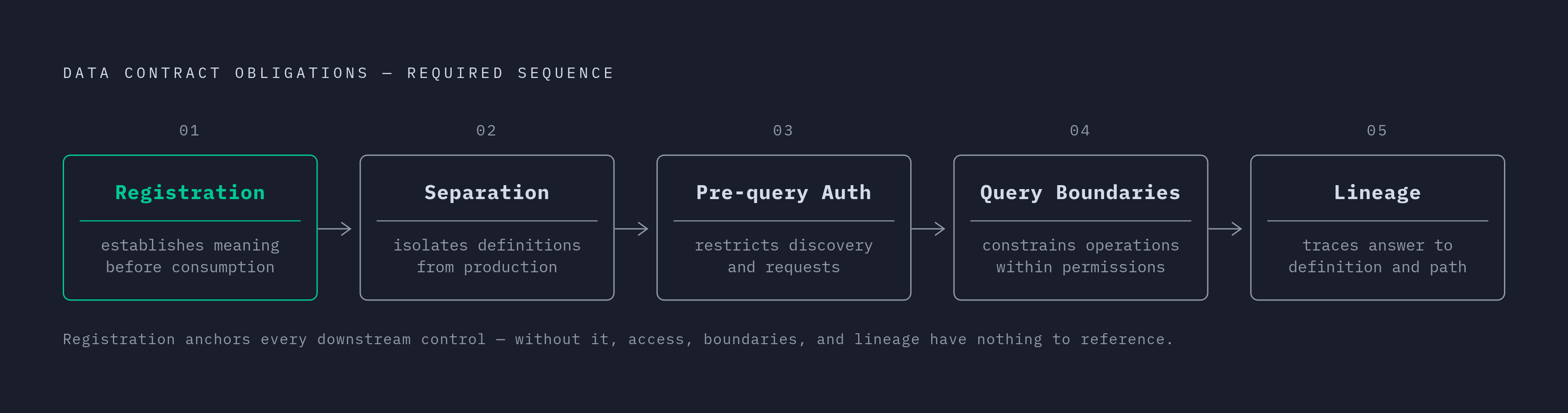
The five obligations form a contract across the backend’s lifecycle. Registration establishes meaning before consumption, while separation places that meaning on data that can be queried without competing with production traffic. Pre-query authorization restricts what consumers can discover and request. Query boundaries constrain the operations available within those permissions. Lineage then connects each delivered answer to its definition, data, and access path after the request has finished.
For a small engineering team, that contract can sound like the separate BI stack it wanted to avoid. The distinction is between obligations and implementation work. A governed data layer that pre-models metrics, materializes queryable datasets, and exposes them through a single MCP server can satisfy the contract without requiring the team to build every layer separately. The selection criteria are therefore concrete, including shared definitions, isolated analytical consumption, scoped discovery, bounded operations, and auditable lineage. Raw API access alone does not establish any of them.
A fractional analytics partner can clean up reporting, define core metrics, and establish a working cadence before a full internal data function is justified. That support helps make the definition contract explicit before software distributes it, while the business retains the final ownership decision. The first-party frontend can then remain a presentation choice rather than the place where every consumer quietly invents a different version of the truth.