What Headless Analytics Means for Supabase Teams
Governed metrics over Postgres give agents trusted numbers safely.
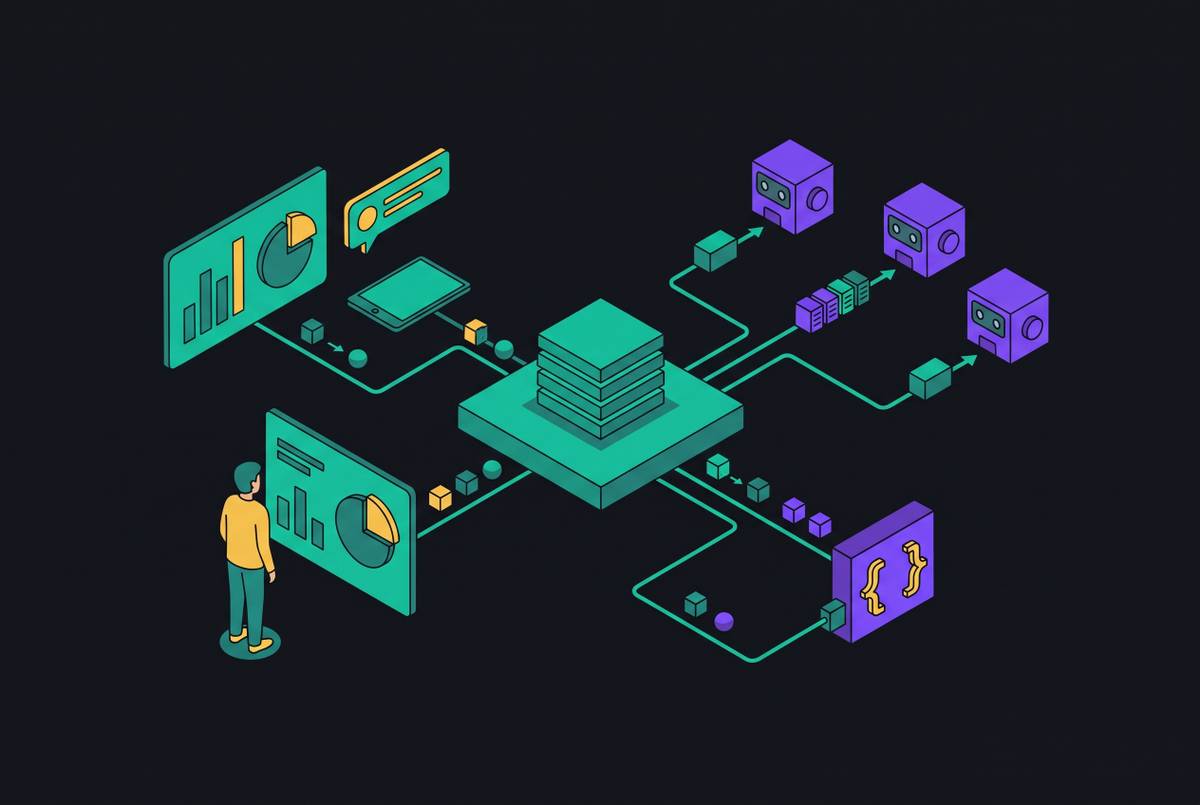
For Supabase teams, headless analytics means separating metric definitions and governed datasets from dashboards and exposing them through MCP and APIs. It gives API-first and agent-first teams an analytics backend without making a prebuilt interface the home of their business logic. The next step is to add a governed analytical layer over the existing Postgres project so human teammates and AI agents can use the same trusted numbers without querying production directly.
What "headless" means when applied to analytics — and why the term migrated from frontend development to the data layer
In frontend development, a headless CMS separates content and logic from the interface that presents them. The content remains available to different consumers without dictating how those consumers look or behave. Moving that principle into data management changes the capabilities being exposed, but not the architectural separation. Data logic is in one layer, and presentation is in another. A standard interface connects them without making either depend on a particular screen.
For analytics, the separation applies to metric definitions and query execution. A semantic layer defines what a metric means and how it is calculated, rather than leaving that logic inside individual charts or reports. The dashboard becomes a consumer of the definition. Once that layer is decoupled, an API client, a Slack bot, or another authorized consumer can reach it without rebuilding the analytical logic.
Why the Model Context Protocol is the mechanism that makes headless analytics real for AI agents
An AI agent needs a way to discover and call that independent layer. Anthropic open-sourced the Model Context Protocol in November 2024 as a standardized way for AI assistants to connect to systems where data lives, including content repositories, business tools, and development environments. MCP supplies the common interface that makes headless data capabilities practical for agents. Without that standard, separating logic from presentation still leaves teams building bespoke connections. With it, compliant agents can discover and call governed endpoints through the same protocol.
Previously, each new agent could require bespoke connectors, custom authentication, hand-coded data quality checks, and its own governance policies. With MCP-native infrastructure, that work happens at the platform layer, so teams do it once for all use cases. The protocol gives the platform a standard way to expose capabilities whose access and meaning are already governed.
Enterprise adoption has made MCP a de facto standard. Informatica's May 2026 announcement made headless data management generally available on Microsoft Foundry and AWS in U.S. regions, with Private Preview on Databricks and Snowflake. Salesforce expanded Headless Data 360 for MCP in August 2026, exposing nearly 200 existing APIs as programmable endpoints agents can call without a UI. For analytics, the consequence is specific. An assistant can use the governed definitions behind a dashboard rather than inventing a separate calculation to answer the same question.
What analytics infrastructure fits Supabase teams that need raw API access — and why the foundation is already there
A Supabase project already has much of the data needed for analytics, including user behavior, transactions, and product events. The project often needs a governed, pre-modeled layer to make the existing data useful to both people and agents. A new destination does not, by itself, establish what a trusted number means.
The conventional response is to extract data into a separate warehouse and build analytics there. That introduces infrastructure, schema divergence, and latency while still allowing finance and product to calculate the same named metric differently after the move. Keeping Postgres as the analytical home ties the extension to the project that already holds the business data. Even with that setup, every analytical request need not run against production tables.
Postgres also has capabilities that make this starting point more substantial than teams may recognize. Row Level Security provides database-level access control, while transaction pooling through PgBouncer addresses connection pressure by letting many users share a small pool. These mechanisms are already available for analytics. They provide part of the foundation for a semantic layer. A Supabase-native headless layer can add governed datasets without requiring ETL, schema changes, or separate infrastructure for the team to operate.
The governance problem that emerges the moment an AI agent can reach your data
Direct production access creates a broad blast radius when an agent has broad credentials and can act at machine speed without human checkpoints. The OWASP Agentic Top 10, published in December 2025, names Tool Misuse & Exploitation (ASI02) and Identity & Privilege Abuse (ASI03) among these failure modes. Broad API access can allow irreversible changes in critical databases before anyone notices.
Access scope also has legal consequences when personal or regulated data is involved. GDPR's data minimization principle in Article 5(1)(c) requires access to be limited to what is necessary for the stated purpose. When agents go beyond their intended scope on HIPAA-, PCI-, or GDPR-governed data, they put the team at risk of breaking regulations as well as disrupting operations. The appropriate access pattern routes agent database queries through a centralized gateway that enforces permissions and logs access. It also uses purpose-specific database users with minimal permissions and directs analytical queries to read replicas.
For Supabase teams, the immediate corollary is that agents should never have production database credentials embedded in their configuration. SQL that executes successfully is not necessarily safe, scalable, or production-ready. RLS mistakes and silent performance regressions can affect production even when a query appears to work in development. Teams therefore need to put database governance in place with care, using policies tied to session settings and forcing RLS even for table owners. These controls establish an access boundary, but another boundary is needed around the meaning and cost of analytical work.
Why pre-calculated, governed datasets — not live queries — are the right unit of analytics for teams running AI agents
That second boundary is a pre-modeled, pre-calculated dataset. The analytical layer defines and calculates a business metric ahead of time, so an agent can use it without working it out from production tables each time someone asks a question. The semantic layer holds calculations such as MRR, LTV, churn rate, and activation rate in one place. This removes the ambiguity in which an “active customer” means paid transactions to finance but daily logins to product.
Governed Parquet datasets queried through DuckDB let requests run against a snapshot. The query runs over prepared analytical data. That keeps the analytical query load off production and gives agents context that is fast and cheap to query. The snapshot is an important distinction, because keeping Postgres as the data home does not require keeping every consumer attached to live production state.
Dreambase implements this pattern for Supabase teams through governed Parquet datasets, DuckDB queries, and a single MCP server. Its metric definitions and query execution are decoupled from visualization surfaces and exposed through MCP and API access. The implementation extends the existing Postgres project without requiring ETL or schema changes. The useful property is the governed dataset that each consumer can query.
Read replicas and RLS remain useful, but they answer different questions. A replica separates workloads, and RLS controls which rows a caller can see. Neither defines MRR or stops two agents from calculating it in different ways over the same rows they are allowed to see. A governed layer can also hold asset classifications and business term definitions so agents know how sensitive the data is and what it means before they query it.
How one governed data layer serves both human teammates and AI agents without fragmenting into a patchwork of tools
In practice, the product dashboard, investor report, and growth spreadsheet should all get their numbers from the same definition. Growing teams often lose metric trust because each surface was built by a different person, at a different time, against a different query. A shared layer removes that duplication at its source. Dashboards, automated reports, Slack digests, and agent responses all call the same metric, which has been pre-calculated. A definition changes in one place and propagates to its consumers rather than requiring separate reports to be reconciled.
A metric can arrive in an inbox, Slack, or a weekly digest without acquiring a new definition on the way. That is operationally different from expecting someone to remember to open a dashboard. A dashboard without an owner can become decoration, while a metric delivered where a weekly decision happens is available when it matters. Headless analytics preserves the choice of surface without surrendering control of the number.
Agents use the same separation to answer questions without requiring the person asking to know the schema. Salesforce's Headless 360, through the Data 360 MCP Server, illustrates how authorized agents can build semantic models, transform data, and generate calculated insights through natural language. For a Supabase team, an agent investigating a drop in a sales KPI can work from the governed metric, segment it by dimension, and describe the contributing factor. The investigation and the board report then share the same analytical basis. Different outputs do not require different definitions.
This is also how a team avoids the complexity creep of adding a separate tool for every reporting problem. With a shared layer such as Dreambase, agents get pre-modeled datasets through one MCP server, and the tools people use get them through the same governed foundation. Adding an agent does not require rebuilding metric logic or creating a bespoke connector and governance policy for that use case. The system can support different workflows without turning each into a separate analytical authority. That is the practical meaning of one source of truth.
What a Supabase team gains in practice by treating Postgres as the analytical home rather than a source to pipe elsewhere
For a founder or small team, the largest gain is a category of work that no longer needs doing. There is no ETL pipeline to maintain, no warehouse schema to synchronize with the product schema, and no separate analytical infrastructure to operate. Early-stage teams generally need a small set of clearly defined metrics, including MRR, churn rate, signups, activation rate, and burn rate. With governance built in, teams can get the same numbers each time without a data engineer having to maintain each report. Engineers can spend less time writing custom queries for one-off requests for reports.
With Dreambase, the implementation path is governed datasets built from the existing Postgres project. The shared MCP endpoint gives additional agents and surfaces a common route to those datasets. This keeps the agent stack’s integration burden at the layer. It also preserves the distinction between extending Postgres analytically and exposing production directly.
The protocol itself still has a moving boundary. MCP's current specification, dated 2026-07-28, is stateless at the protocol layer and replaces native protocol-level session management with explicit application-layer handles. It supports stateful multi-turn workflows through Multi Round-Trip Requests (MRTR), so governance implementations may need revisiting as the protocol matures. That is a reason to keep durable metric definitions and access controls in the governed layer. The infrastructure choice made now determines not only today's reporting quality, but also the safety and reliability of the AI workflows a Supabase team adds next.