Audit Trails and Permission Models When AI Agents Read Supabase Metrics Through MCP
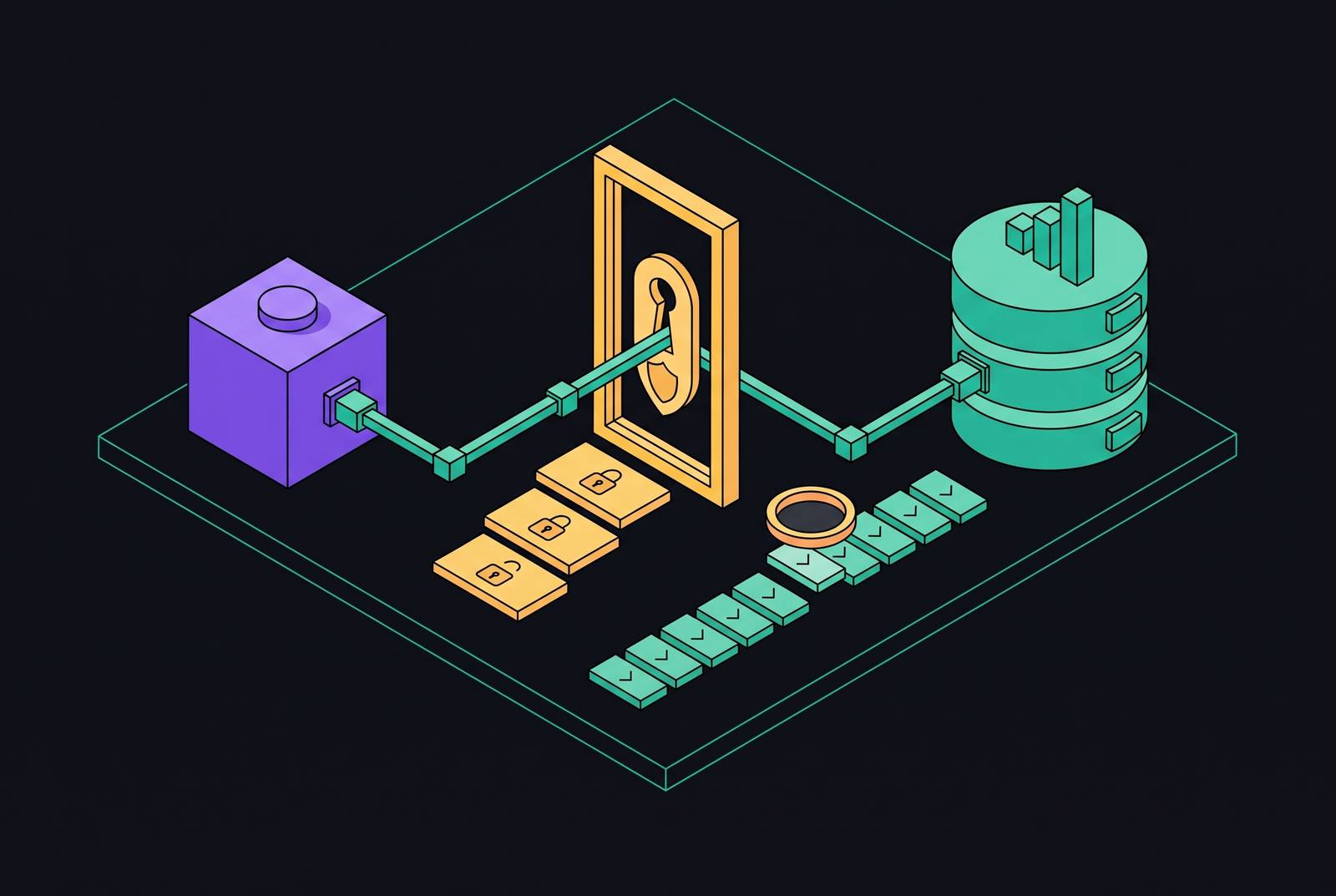
For AI agents on Supabase via MCP, governed data access needs a layer between agents and production tables that has pre-modeled metrics, per-user authorization, and identity-aware audit logging. Agents should query governed datasets without receiving direct database credentials. The central requirement is accountability across three identities, because recording the agent software and its account does not establish which human decided the action should happen.
The three-identity problem MCP creates and why standard audit trails miss it
Alice starts an approval, sends the link to Bob, and Bob signs in and completes it. Alice’s agent then inherits Bob’s permissions. The MCP specification documents this attack and requires the server to verify that the person completing an approval is the person who started it. Without that check, the CRM record shows Bob’s account at work while the MCP server record shows Alice’s approved flow. Neither record is wrong, but neither explains what happened.
MCP accounts for the person in this specific mid-task approval flow, but otherwise does not require establishing which person is acting. This is a deliberate boundary of the protocol’s scope that also applies to Supabase deployments. An audit record assembled only from MCP messages can identify software and account authority without identifying the person whose decision caused their use.
Securing the Model Context Protocol (MCP): Risks, Controls, and Governance describes the shift from static, developer-controlled API integrations to dynamic, user-driven agent systems. What a human wants can change, while a fixed code path stays the same. Consequently, a record of authorized execution is not a complete record of responsibility. The three identities are the agent software, the OAuth account whose permissions it uses, and the human who decided the action should happen.
Why the attack surface around this gap is already active, not theoretical
By early 2026, security researchers had catalogued nearly 7,000 internet-exposed MCP servers, with roughly half operating without authentication controls. Real incidents from 2025 included cross-tenant data exposure at Asana, prompt injection attacks against the GitHub MCP server, and unauthenticated remote code execution in Anthropic’s MCP Inspector developer tool. Malicious npm packages were used in multiple supply chain compromises, giving attackers another way into the infrastructure.
These incidents involve different controls, but they share a governance consequence. Once an agent can retrieve data, preventing unauthorized access and explaining authorized access become separate obligations. A server may authenticate an account correctly but still lack the details about the human’s decision that would explain why private data went into an agent workflow.
The Postgres MCP server, the most popular database MCP server by community stars and usage, recommends using the narrowest query that answers the task and avoiding unrelated secrets or personal data. That guidance relies on adherence to the recommendations for access limits. When MCP tools retrieve production rows, logs, IDs, and email addresses, that data goes to the connected AI provider as input. Without identity-aware audit trails, the record cannot show how a person’s decision led to that data flow.
How Supabase permission models interact with the identity gap
Supabase’s Row Level Security provides strong per-user isolation for application traffic through policies built around auth.uid() and user session context. That model fits an application serving individual users. It does not automatically fit an analytics service or an agent that needs to read across users. An agent asked to “show me all orders above a threshold” cannot produce a complete cross-user result under policies that expose only one user’s orders.
Resolving that tension introduces a governance choice. A developer can grant a role that bypasses RLS or add analytics-shaped policies to the production authorization model. The former broadens authority, while the latter introduces another access purpose into rules designed for application users. Neither choice establishes who initiated the agent’s task. Column-level privileges can keep sensitive fields out even when row access is allowed, but teams must set up that protection.
Service-role keys make the distinction especially important. They can bypass RLS entirely and must be protected. If an MCP server holds such a key, every agent call it serves operates with that key’s authority regardless of the human who caused the call. A table with RLS enabled and no policies returns no rows, which protects against accidental exposure. That default does not fix policies that are disabled or leave too much unspecified, and a shared privileged credential still does not give each person their own authorization.
What least-privilege access control actually means for non-human agent identities
Scope agent authority to the current task. That is harder than it sounds for agents. Their usefulness comes from flexible execution across systems, so broad permissions can appear to be the simplest way to preserve that flexibility. Least privilege instead grants only the data, systems, and actions needed for the task, limits access to its duration, and revokes it automatically afterward. Those grants also require continuous review.
This scope has to hold at several levels. Tool-inventory controls limit the tools the agent sees at initialization, while invocation controls allow a selected tool only when the current step requires it. Argument controls narrow authority to the specific object, query, or payload. Data controls limit what comes back and redact sensitive fields. Delegation controls prevent a sub-agent from receiving more authority than its subtask needs.
A workflow crossing several systems amplifies a misconfigured permission beyond the reach of an equivalent traditional service account. Singapore’s IMDA Model AI Governance Framework for Agentic AI calls for least privilege over the tools available to each agent. Singapore’s Cybersecurity Agency Addendum similarly advises limiting execution privileges to what is necessary. These are advisory frameworks, while the MCP governance paper identifies per-user authentication, scoped authorization, and containerized sandboxing as concrete defense-in-depth controls.
The audit trail gap: why scattered per-server logs cannot answer the question an auditor asks first
Auditors first ask what one agent did for one person across everything it accessed. Per-server logs cannot provide that answer on their own. Each MCP server records its own slice of a cross-system workflow, in its own format, without a common schema for agent identity, session, or human initiator. The person field omitted from protocol messages is also missing from those records. Collecting the logs therefore does not resolve the identity gap.
Per-user OAuth 2.1 flows help close this gap by letting users authenticate to connected services with their own credentials in place of shared organizational tokens. They support finer permission scopes and individual revocation without disrupting other users. However, identifying the authenticated user still requires preserving the relationship between that user and the initiated task.
At Level 4, Zero-Trust Architecture with Continuous Verification, Cloud Security Alliance MCP Best Practices requires immutable, append-only audit logging that is kept apart from the systems it monitors. Otherwise, a compromised server can alter its own access history precisely when that history is most needed. ContextNest adds a second dimension through its account of context governance. Even when retrieved information is correct, a procurement-agent workflow needs a record of which version informed its decision, who approved it, and whether it was current. Auditing actions alone leaves the knowledge behind those actions unexplained.
How can AI agents query Supabase metrics without direct database access?
A governed metrics layer can pre-model Supabase data into certified datasets and expose them through a single MCP server. With pre-calculated Parquet datasets queryable through DuckDB, agents read governed exports of production Postgres tables. This removes the need for agent queries to bypass production RLS. Access policy still has to govern the export, but the agent’s analytical authority no longer depends on its ability to scan live application tables.
Without shared definitions, agents generating SQL against raw tables can construct divergent business formulas. Headless BI separates definitions from dashboards, defining ARR, churn, and CAC once as code and exposing them through a governed API. A dashboard, Slack alert, and AI agent can then receive the same metric from the same definition. MCP support gives agents a standard way to reach those definitions without having to generate separate SQL.
dbt Labs’ 2026 benchmark found that an LLM answered questions more accurately through a semantic layer than through its own generated SQL on a modeled project. Claude Sonnet 4.6 achieved 98.2% through the semantic layer, while GPT-5.3-Codex achieved perfect scores. Both performed less accurately with their own SQL.
A single MCP entry point also provides a common enforcement and recording boundary. Agent identity, account, task context, and the human initiator established through per-user flows can be recorded in one schema before data access. Centralization provides the place to close the identity gap. It does not establish the human relationship automatically.
How to design audit and permission infrastructure for agents from the start, not retrofitted
Before tool selection, teams should give every agent a managed identity that is separate from human accounts and service accounts, so the agent field names a known actor. SMCP: Secure Model Context Protocol identifies unified digital identity and trust infrastructure as foundational to protocol operation. Where agents act for specific humans, per-user OAuth 2.1 flows should replace shared organizational tokens. The task that was started must stay linked to that authenticated identity.
Teams should then have agents get data through a single governed layer without handing out database credentials. This creates one place for least-privilege enforcement, column-level redaction, and consistent audit capture. Each call’s record should include agent identity, account, human initiator where established, tool invoked, arguments, and result. The log must be append-only and isolated from monitored systems. Tool-inventory, invocation, argument, data, and delegation controls should apply from the first deployment, before broad permissions become dependencies of running workflows.
Read-only access still requires these controls: it removes write-back risk, but a model exposed to prompt injection can still leak private data through its response text. Observability must therefore cover access as well as database health. Supabase’s Metrics API exposes roughly 200 Postgres performance and health metrics in Prometheus exposition format, which can be connected to the governed layer’s monitoring infrastructure.
Reconstruction also requires more than the returned data. ContextNest’s provenance model suggests keeping a record of the metric-definition version used for each result. An auditor six months later needs to establish what the agent knew and whether that knowledge was approved for AI consumption at the time.
Why governance theater is the default outcome and what separates it from real control
Governance theater begins when proof of configured controls is treated as proof of accountable decisions. Account logs, endpoint restrictions, and per-user RLS help protect data, but none on its own shows who decided an agent should act. The missing relationship is easy to overlook because each individual control can operate correctly. The failure appears only when the records must explain the whole workflow.
Real control has both a retrospective and a preventive test. The audit trail must reconstruct which human caused which agent to access which version of which metric. The permission model must also have prevented that agent from reaching data outside its task. For Supabase teams, pre-modeled datasets, a single MCP entry point, per-user flows, and isolated append-only logs provide the architecture for those tests.
The CSA guidance concludes that MCP security requires defense in depth across authentication, tool integrity, session management, supply chain validation, execution isolation, and behavioral monitoring. No single access layer replaces those responsibilities. Teams also need to keep checking provenance, version identity, and integrity verification as data and metric definitions change. Singapore’s frameworks signal that least privilege and audit completeness are becoming baseline expectations even where they are not binding. The system must be able to explain and constrain a human-directed agent decision.