Governed Metric Contracts as the Analytics Interface for Headless Agent Instrumentation
Governed contracts make metrics trustworthy infrastructure for autonomous agents.
For API-first and agent-first teams, a headless analytics backend should expose governed business metrics through APIs and MCP without requiring an opinionated frontend. Governed metric contracts make that architecture trustworthy by defining what each measure means and enforcing its rules before queries reach data. They are not better documentation, but the permanent interface between an analytics layer and its human and agent consumers.
Why ambiguous metrics became a structural defect once agents entered the loop
For two decades, an ambiguous metric cost a meeting. Two dashboards disagreed, someone noticed, and a reconciliation call consumed time that could have gone toward a decision. Human attention acted as an imperfect checkpoint between a disputed number and its use. The definition could remain informal because the people consuming it could question it.
Agents removed that checkpoint without removing the ambiguity. They run business logic all the time, answer questions, and feed downstream automation with no person there to spot a disagreement. A missing filter can therefore become an input to another action. Early deployments produced self-disagreeing assistants, numbers that matched nothing, and security findings. The failure changed in kind because interpretation became part of autonomous execution.
What a metric contract actually is and what distinguishes it from a schema contract
A metric contract is a versioned, owned, testable declaration of what a business measure means. It must be complete enough that independent consumers compute the same result or do not compute it at all. A schema contract answers a different question. It governs column names, types, nullability, and freshness, all of which can be correct while two teams still calculate different revenue figures.
A complete metric contract specifies five things beyond those column guarantees. The calculation is the exact expression. Inclusion and exclusion rules say whether to count cancelled orders, internal test accounts, or intercompany transactions. The grain states what one result row represents and which dimensions support valid slices. Temporal semantics identify the filtering date, fiscal calendar, and treatment of late-arriving data, while ownership and lifecycle identify the accountable person, version, changes, and retirement of the previous version.
A versioned YAML definition of pipeline_conversion_rate, for example, brings its calculation, filters, grain, and temporal rules together with invalid dimensions, tests, and lifecycle information. These determine which uses of the expression are valid. The completeness test is behavioral, requiring two independent implementations to produce identical numbers from identical data using only the contract. An unstated timezone or assumed filter fails that test even when neither implementation contains a programming error.
Data contracts and metric contracts therefore compose vertically. The former stabilize datasets at their producer boundary, while the latter define business measures over those datasets. A breaking change below the metric requires impact analysis above it.
How agent proliferation promoted metric definitions from documentation to infrastructure
The discipline hardened in 2026 because consumers multiplied, execution became autonomous, and computed figures reached beyond internal analysis. An analytics assistant, customer-facing copilot, workflow agent, and orchestration layer can each use different context and retrieval conventions. Prose definitions reach those consumers unevenly, if at all. Once each framework interprets business logic independently, adding a consumer also adds another opportunity for divergence.
Autonomous execution makes that divergence harder to contain. An architecture in which agents select governed definitions rather than derive them depends on a complete, current catalog. The catalog is now an execution dependency. When its figures enter customer communications, partner reports, or regulated disclosures, their provenance must lead to a versioned definition and approval history.
DABStep results reported by agentic-data-contracts 0.61.0 give this distinction an empirical basis. Governed contracts materially outperformed both schema-only and manual-prompt approaches across model families. The governance boundary also held under those tests. Both governed arms submitted zero mutating SQL statements, while ungoverned arms submitted mutating statements. The result supports treating definitions and enforcement as infrastructure rather than relying on instructions to compensate for missing structure.
Interchange made that formalization more affordable. The Open Semantic Interchange initiative finalized its core specification in early 2026, establishing a vendor-neutral representation for semantic models and metrics. A definition written once need not depend entirely on one vendor’s format or longevity.
Why a contract must carry API-grade guarantees: versioning, ownership, testing, and change control
Production engineering guidance follows from this dependency on the catalog. Version contracts for both breaking and non-breaking changes, name an owner, test them in CI, and run downstream impact analysis on changes. These guarantees must accompany the definition itself. Informal descriptions cannot reliably tell consumers whether a result changed intentionally, who approved it, or whether existing uses remain valid.
Versioning must distinguish a changed measure from a changed label. Adding a filter that removes rows is a breaking change, while renaming a label is not. Declare that distinction in the contract so consumers know whether historical values need recomputation. A version number without a declared change meaning leaves the consumer to infer the consequence. Lifecycle information must also state when the previous version stops being served.
Assign ownership to a person. That person approves changes, answers consumer questions, and decides when a version retires. If the person leaves, the metric must appear on an ownership list that someone is responsible for clearing. Accountability has to survive both a disputed result and a staffing change.
Keep tests inline with the definition so CI can enforce them without depending on a separate repository that drifts out of sync. The package adds corpus-level validation by rechecking verified examples against the contract and its certified answers. This catches a quieter failure than invalid SQL. A query can comply with the rules and still return the wrong number after a contract or warehouse schema change.
Change control must propagate impact analysis upward from datasets to dependent metrics. It must also include permitted dimensions and invalid dimensions with reasons. An agent requesting an invalid slice should receive a rejection explaining why. Those exclusions make the boundary explicit before consumers depend on an unsupported interpretation.
How the MCP layer turns governed contracts into the actual access interface for agents
MCP turns the governed catalog into an interface agents can consume, but it does not create the governance behind that interface. More than 10,000 MCP servers were deployed in production by mid-2026. The servers gave more consumers access without ensuring that their analysis was correct. MCP does not clean, transform, or govern data, so those responsibilities must be satisfied before its server exposes the analytical surface.
Its three primitives have distinct roles in this architecture. Tools do things such as run a governed query, while resources give context such as schemas and governed datasets. Prompts supply reusable templates for repeatable analytical workflows. The contract determines the valid meaning and scope of the work those primitives support.
The July 28, 2026 specification revision made MCP stateless at the protocol layer. Requests could reach any server instance behind a plain round-robin load balancer, which made horizontal scaling easy. Scaling transport does not settle authorization or metric meaning. The U.S. National Security Agency stated in a May 2026 Cybersecurity Information Sheet that MCP’s proliferation had outpaced development of its security model.
The governed layer must sit between data and the MCP surface, bringing together pre-modeled datasets, definitions that have owners, and per-caller row and column security. The package implements principal-based permissions through allowed and denied tables and filter values. Those constraints belong inside the contract. Access then depends on enforceable rules.
What analytics infrastructure do Postgres and Supabase teams need for raw API access from day one?
As of October 2026, tens of millions of developers used the platform, which was launching over 4 million databases per month. Most new databases were created by agents or AI-driven tools. Contract discipline cannot be reserved for a later reporting project when automated consumers are present at database creation.
Supabase provides native observability through OpenTelemetry integration for logs, metrics, and traces, plus a Metrics API exposing Postgres metrics compatible with an open-source monitoring system. Those tools describe infrastructure health. They cannot prevent two agents from calculating different revenue figures from the same tables. Raw API access answers how a consumer reaches data, while a metric contract answers what that consumer may validly compute.
Postgres also imposes resource and isolation constraints on agent access. A read-only role does not prevent a poorly formed query from holding a connection open, and repeated execution can exhaust the pool. The engineering response is a dedicated low-privilege pool for agent traffic, separate from the application pool. Read-only access limits writes without protecting application capacity from expensive reads.
Row-level security also depends on how tenant context is handled. If an agent can influence session context through a tool argument, prompt injection can create a path to data theft even with RLS enabled. Through a shared pool, SET LOCAL scopes context to the current transaction rather than allowing session settings to bleed across requests. That addresses context leakage, while contract-level permissions govern the caller’s analytical access. A governed copy served through MCP provides the durable separation from production, keeping autonomous queries away from application connections and live-table metric invention.
Why startups and small teams cannot defer contract discipline until they have a data team
The early-stage objection is legitimate because contracts require maintenance. Many pre-Series A teams struggle to keep up with versioning, tests, and named ownership. Assigning those duties to a future data team leaves current agents and consumers to establish their own definitions in the meantime.
The alternative incurs a different maintenance burden. When many agents work without contracts, each disagreement can create another metric until the catalog has several revenue variants with no clear link between them. A small team can govern five definitions rigorously through one authoritative foundation of measures, filters, and dimensions rather than allowing that scope to sprawl into nine revenue variants.
This discipline applies to executive consumption as well. Every metric on a CEO dashboard should reconcile to a single source, with ARR from the billing system, cash from the bank, and product usage from the analytics layer. Separate sales, finance, and product versions turn decisions into reconciliation exercises. Named ownership connects that requirement to someone’s actual job.
How metric contracts become the stable coordination layer across every consumer in a headless analytics architecture
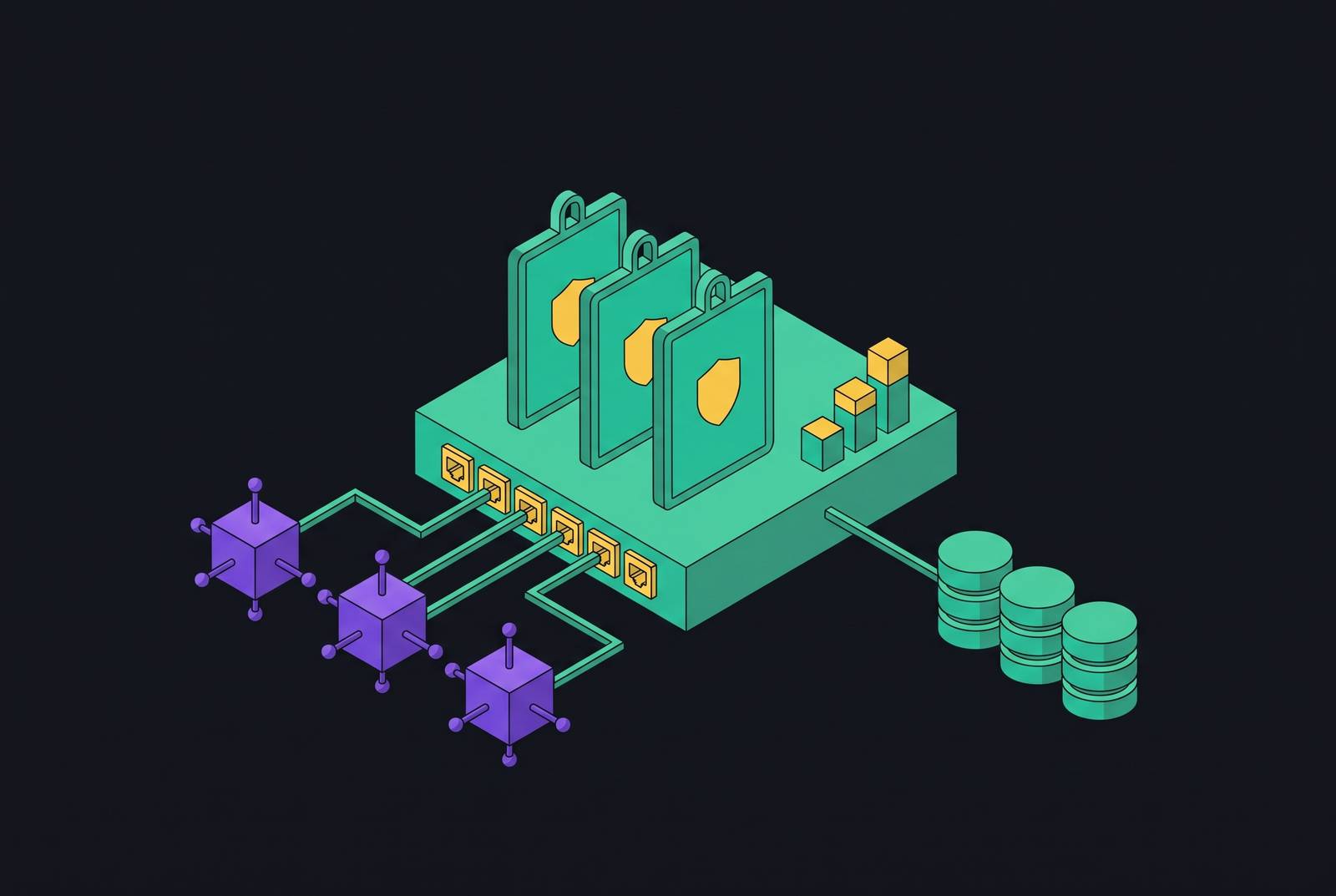
In a governed headless architecture, one contract serves BI dashboards, agent frameworks, Slack-pushed reports, and API callers. Consumers need not understand the underlying data model to use the measure correctly. Definition is decoupled from delivery through the contract. Full API control and the absence of a prescribed frontend are compatible with strict governance because the rules reside below the consumer interface.
That shared layer consists of pre-modeled datasets queryable through DuckDB, with optional pre-calculated materializations, exposed to agents through MCP. Contract rules are enforced before execution against the governed data. Agents get context that is fast, accurate, and cheap-to-query without touching the production database. For Supabase teams, this separation joins business metric consistency to production isolation.
The catalog becomes the coordination mechanism across frameworks. Agents choose definitions, invalid interpretations show up as contract violations, and outputs sent to customers can be traced to a versioned measure with approval history. The same definitions can reach people through inboxes, Slack, or dashboards without being rewritten for each destination.
Multiple valid metrics can exist for distinct uses when each is named, documented, and derived from an authoritative foundation. Small teams establish that foundation with a limited catalog, and larger estates extend it without making every consumer a new definition surface. Contracts are the permanent interface that scales from five KPIs to fifty without losing trust.