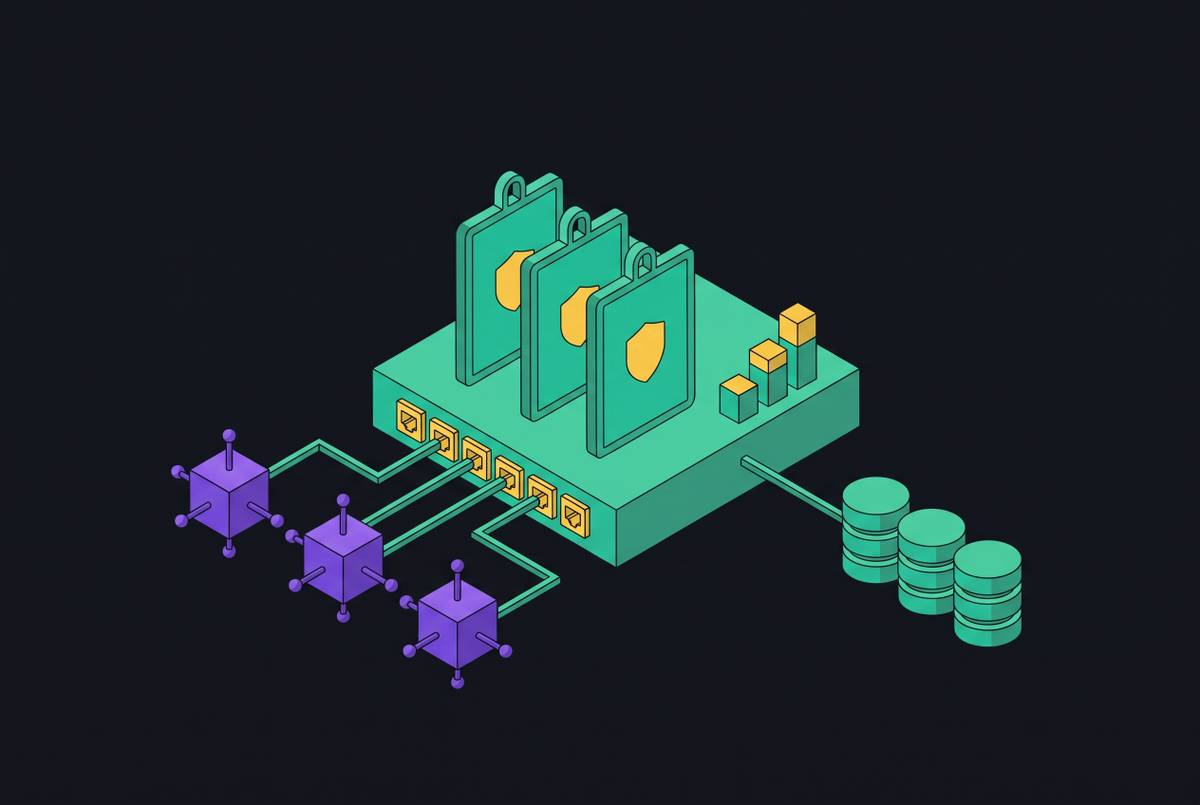
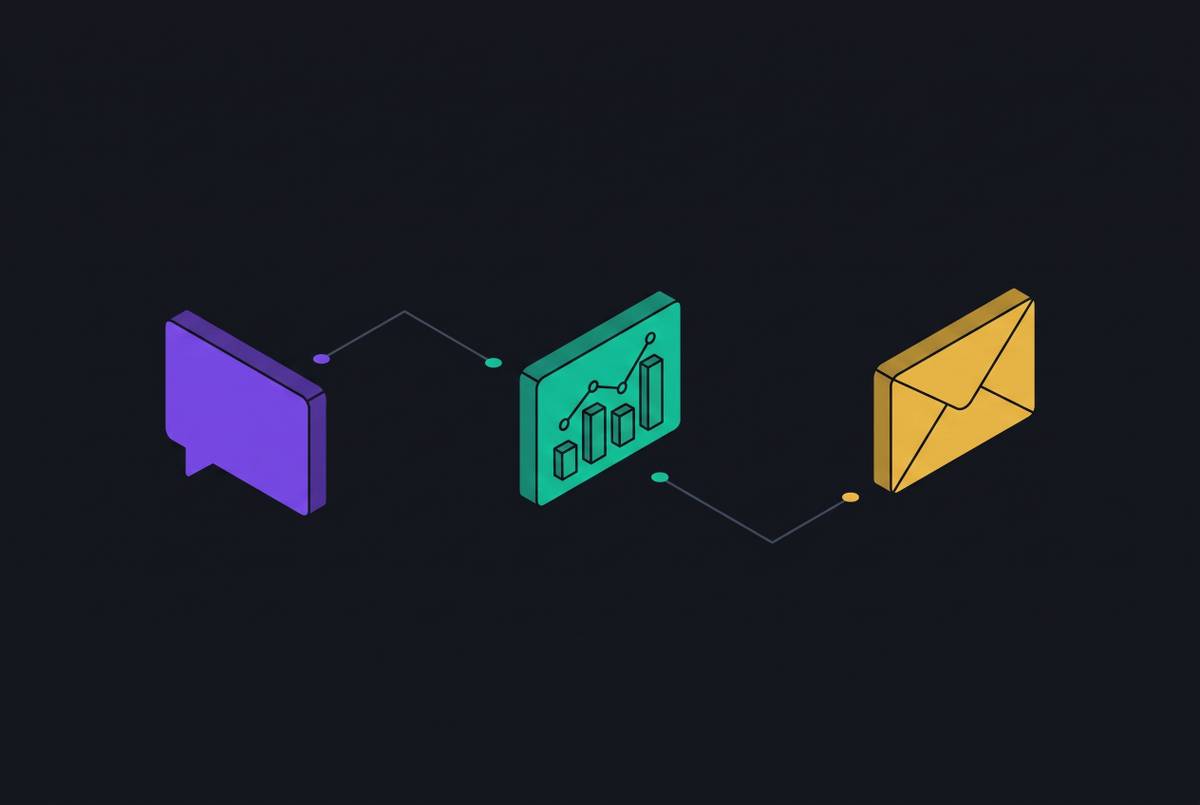
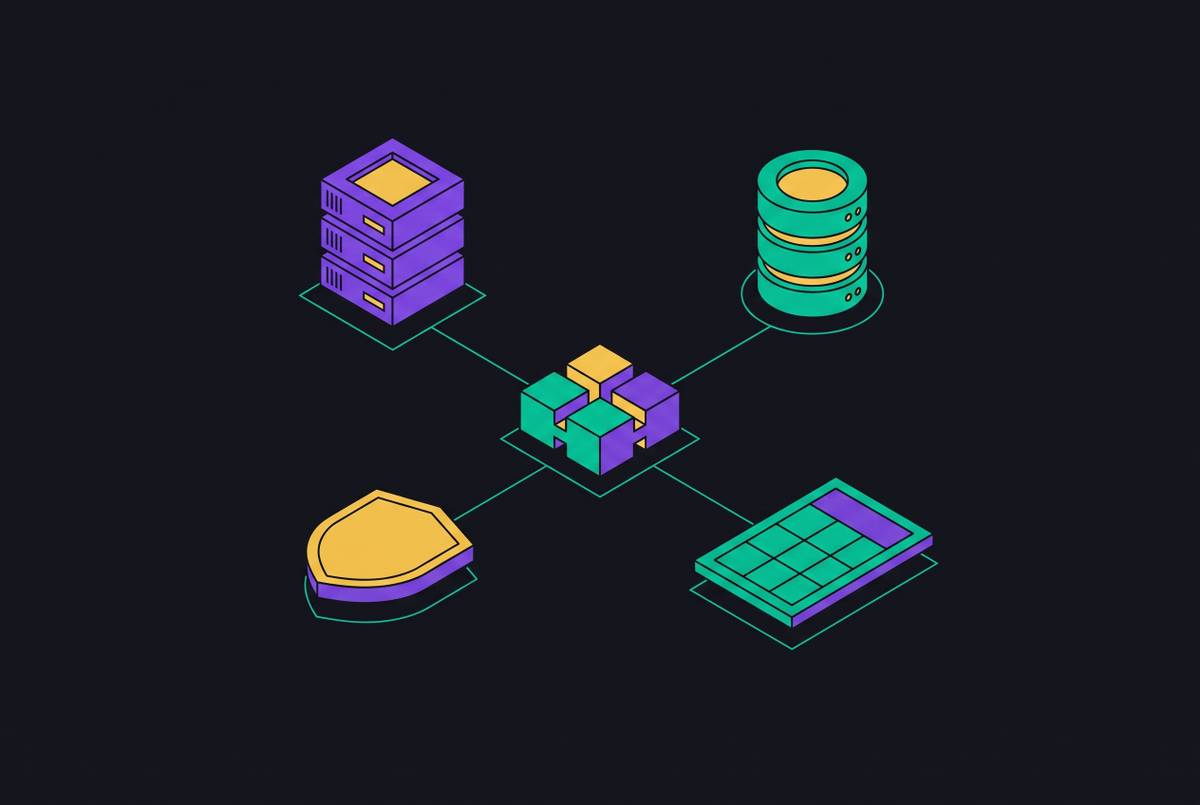
MCP Resource Registration as the Governed Boundary Between Supabase Data and Agent Consumers
Registering pre-modeled datasets as MCP resources keeps agents' reads governed.
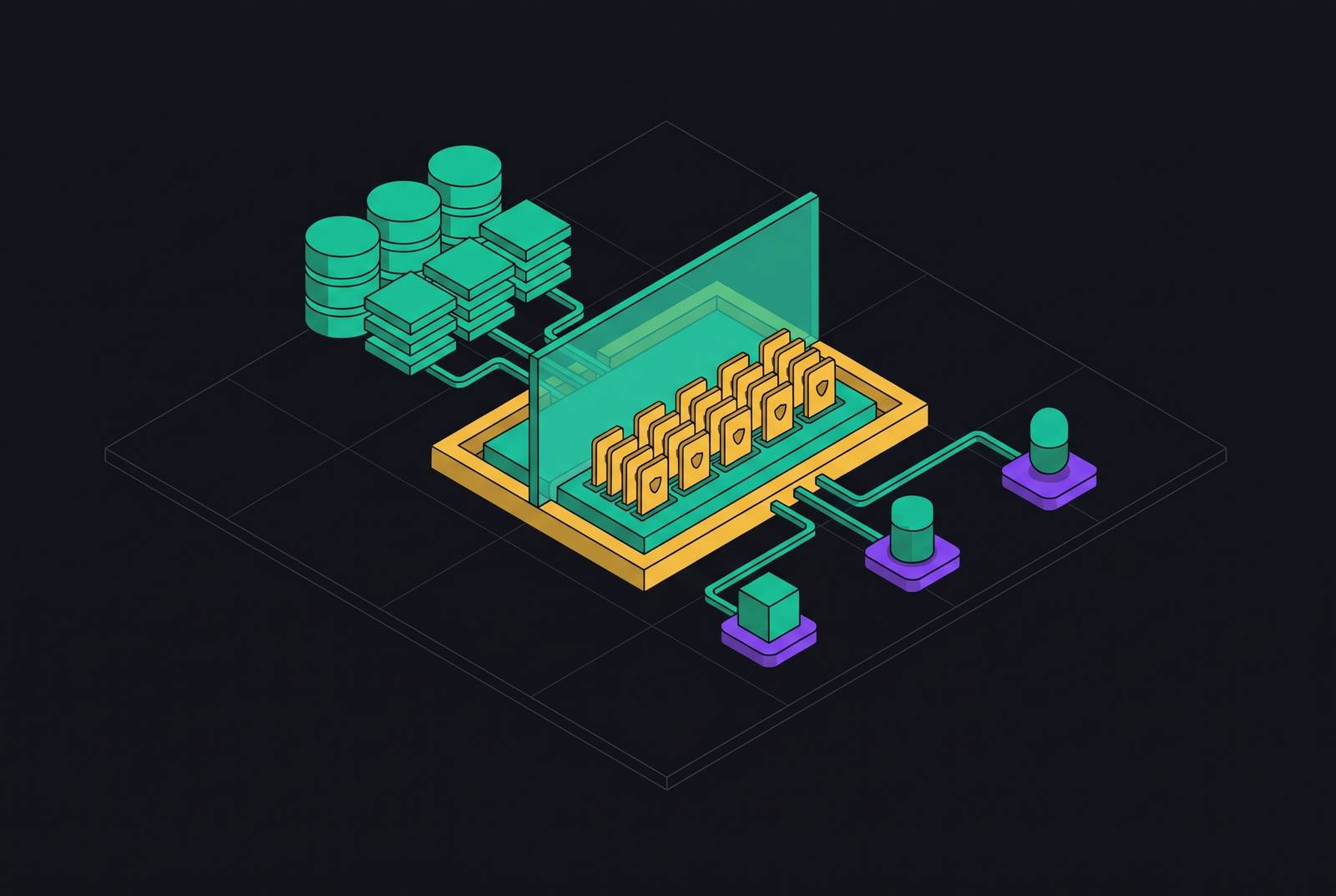
For API-first and agent-first teams on Supabase, headless analytics should expose governed datasets without requiring an opinionated frontend or giving agents open SQL access. MCP resource registration is the architectural boundary that declares what an agent may read, in what shape, and under what constraints. A shared, pre-modeled data layer can serve agents through MCP and support dashboards and reports without letting each consumer redefine the metrics.
Why MCP exists: the integration problem agents inherited from humans
Before MCP, each agent framework built its own tool-calling abstraction. Connecting a new data source therefore meant building an adapter for every framework that needed it. The cost multiplied across the ecosystem. A database available to a coding agent was not automatically available to a chat interface or an autonomous workflow, even when all three needed the same data. Each integration also created another path through which access had to be understood and controlled.
A Survey of AI Agent Protocols identifies the lack of standardized protocols as a bottleneck for interoperability with external tools and data sources. MCP changes the integration model from N×M to N+M, because one MCP server for a datastore can serve any compliant client. Supabase’s hosted server makes that model concrete for its projects. Standardization also consolidates the place where access can be supervised. A security team can log, rate-limit, and authorize requests at one audit boundary instead of tracing calls through the APIs of each framework.
What MCP actually exposes: the three primitives and why resources are different
That common boundary can expose very different kinds of access. MCP servers provide tools, resources, and prompts, but those primitives are not interchangeable governance controls. Tools are callable functions that can act on the world, including running SQL, applying migrations, or deploying functions. Prompts are reusable templates that guide a workflow. Resources, by contrast, are read-only data addressed by URIs.
The distinction is between a capability and a declaration. A SQL tool lets an agent formulate a request whose result depends on the statement and the database permissions behind it. A registered resource names a data surface with a defined shape and scope. The agent protocols survey classifies MCP as context-oriented, which places this control over received context at the center of the protocol’s purpose.
Restricting an agent’s actions does not necessarily restrict the information it can accumulate through reads. An autonomous agent can reason across multiple calls, retaining context from each result and using it to frame the next request. Early inputs shape what comes next. When those inputs are malformed or unnecessarily broad, the resulting reasoning can inherit their defects even if every individual call is authorized.
This makes the declared dataset both a security boundary and an analytical contract. Its scope determines which information enters the agent’s context, while its shape determines how consistently that information can be interpreted. A prompt may tell an agent to use a metric carefully, but the registered resource can supply the metric in an already defined form. Those are different kinds of control.
How the Supabase MCP server translates this into access controls a team can actually set
Supabase’s MCP server provides three URL-level parameters for narrowing a connected agent’s reach. The project_ref parameter limits access to a single Supabase project, preventing movement into other projects through that connection. The read_only=true parameter runs SQL sessions as the dedicated supabase_read_only_user Postgres role. This prevents writes, migrations, and deletions through that session. The features parameter restricts the available tool groups, allowing a team to expose database tools while suppressing edge functions, branching, or storage.
These controls establish a practical starting boundary. They distinguish which project the connection reaches, whether it can change data, and which categories of operation it exposes. The server is hosted and uses OAuth 2.1 with automatic token refresh, avoiding local binaries and hardcoded credentials in agent prompts. Authentication and scope are therefore configurable outside the model’s instructions. They do not depend on the agent remembering a request to stay within a particular project.
Within the database, the effective Postgres role determines access. Row-level security can restrict agent queries where those queries are subject to the table’s RLS policies, rather than relying on a prompt to describe which rows are permitted. Service-key credentials are an important exception because they bypass RLS. The recommended configuration is a dedicated Postgres role for the MCP server, rather than the built-in anon or service roles intended for web-app traffic. That role should have explicit connect rights and schema-level usage grants, and agent sessions should not get service-key credentials.
Supabase also wraps SQL results with instructions intended to discourage the model from following commands embedded in returned data. That addresses a different part of the boundary. Database grants set what can be read, while result wrapping tries to guide how the model reads that content. Neither function substitutes for the other. Together, these controls provide connection scoping, database permissions, and a mitigation for instructions hidden in results, but they do not by themselves turn arbitrary SQL access into a registry of governed analytical datasets.
Where the Supabase MCP boundary breaks down under agent behavior
A read-only connection can still expose too much. An agent with read_only=true and access to the SQL tool can compose arbitrary read queries against any production rows its role permits. Project scoping limits the location of those queries while leaving their analytical scope unrestricted. A mistaken grant is a configuration defect that becomes a runtime access problem.
Information Fidelity in Tool-Using LLM Agents: A Martingale Analysis of the Model Context Protocol examines how distortion accumulates across sequential calls. Its framework finds that distortion builds up in a linear way, with high-probability deviations bounded by O(√T). The distinction keeps the reliability claim precise. It shows why the fidelity of each input in a sequence matters, though it does not prove that every extra row causes an error. Context that is irrelevant or distorted can, if picked up early, affect later reasoning even after a call ends.
Returned data can also contain hostile instructions. Prompt injection exploits the point at which a model treats database rows, documents, tool descriptions, or parameter schemas as directions. Supabase’s result wrapping reduces this risk but cannot guarantee that a model will ignore embedded commands. Read-only permissions prevent database changes through the session, with no guarantee that the contents of every readable row are trustworthy.
Credential choice creates another failure path. MCP does not prevent a team from supplying service-key credentials, so the protocol cannot restore RLS protections that those credentials bypass. In multi-server stacks, similar tool names can also lead a model to call the wrong server, making the mistake difficult to distinguish in logs that do not clearly separate those names. These failures in the access path need more than changes to prompt wording to fix. The analytical boundary therefore needs to be enforced above the tool layer, through a declared data scope that holds even when the agent chooses a careless query.
What governed resource registration actually requires: pre-modeled, URI-addressed datasets instead of open SQL
Each registered resource has a name, a URI, a defined shape, and a known scope. That declaration happens at design time. The agent receives access to the declared artifact rather than discovering the limits of its access by composing SQL against production tables.
Metrics can be pre-calculated into governed Parquet datasets queryable through DuckDB, so an agent reads a typed snapshot rather than assembling live joins against production Postgres. The production database is no longer the target of those agent reads. Within this pattern, arbitrary agent-authored production SQL, row-level side effects, and connection-pool pressure from those reads are removed from the consumption path. Creating the dataset remains a separate concern from consuming it.
A semantic layer defines each metric once, pre-calculates it, and exposes the result through the governed dataset. Agents reading revenue, churn, or DAU then use the same definition rather than supplying their own implicit interpretations in SQL. Shared tables alone cannot provide that consistency. Two agents can read the same records yet give different answers because they use different joins, filters, or metric definitions.
Authorization must still protect the registered surface. The official MCP specification requires servers to validate that access tokens were issued for them as the intended audience, and requires clients to implement PKCE according to OAuth 2.1. Audience binding prevents a token intended for one server from being accepted by another intended audience. It is not, by itself, a declaration of dataset-level permission within the same server. The registry remains the enforcement point for which authorized clients may reach which declared resources.
A typed dataset can still contain text that a model misinterprets, and authentication cannot decide whether a metric definition is correct. What registration provides is a tractable contract. The team can set the data scope, analytical definition, and which consumers are allowed, without leaving those choices to each generated SQL statement. That is the distinction between governing an analytical interface and merely authenticating access to a database tool.
How can a Supabase team add agent analytics without a prebuilt dashboard or new infrastructure?
For a Supabase team, this pattern treats Postgres as the analytical home rather than as a source that must move into a separate warehouse. Pre-modeled datasets extend the project, and an MCP server exposes them as typed, URI-addressed resources. Governed Parquet datasets queryable through DuckDB provide the materialized layer. Agents read stable snapshots instead of querying live production tables for every answer. The team is meant to run this without a separate warehouse, ETL pipeline, or dedicated data engineering role.
The headless distinction is the separation of data access from presentation. An agent consumes a registered dataset through MCP, while human-facing dashboards and reports can use the same governed data. A prebuilt dashboard is not the analytical contract. For teams evaluating API-first analytics infrastructure, the relevant criteria are control over the access interface, stable metric definitions, explicit dataset scope, and independence from an opinionated frontend.
Choosing what to materialize begins with Postgres observability. Supabase’s Logs and Analytics feature, powered by Logflare, tracks events from the API gateway, Postgres, Storage, and Edge Functions. Its Metrics API exposes Postgres metrics in a monitoring-compatible format, including CPU, IO, WAL, connections, and query statistics. Query frequency and expense then inform which workloads should move from an unrestricted SQL interface to a stable registered resource.
RLS performance belongs in that diagnosis. Running auth.uid() again for each row can make a protected query costly, while using (select auth.uid()) as a scalar subquery lets the planner run it once. The number of active connections compared with max_connections, cache hit ratios, and statement-level statistics from pg_stat_statements help tell whether problems come from the schema, connections, or capacity. That distinction gives materialization a workload basis instead of treating every slow query as a reason to add infrastructure.
The access path has one MCP server, one resource registry, and one audit log, in place of separate integrations that link agents to individual tables. It extends the Supabase project without requiring application schema changes or new infrastructure for the team to manage. Its value also reaches beyond agent consumption. When dashboards, reports, and agents share the same governed datasets, presentation can change without forcing a new definition of the underlying metric.