The Query Lifecycle When an AI Agent Requests Analytics Through an MCP Server on Supabase
Governed metrics and row-level access control protect both data consistency and database resources.
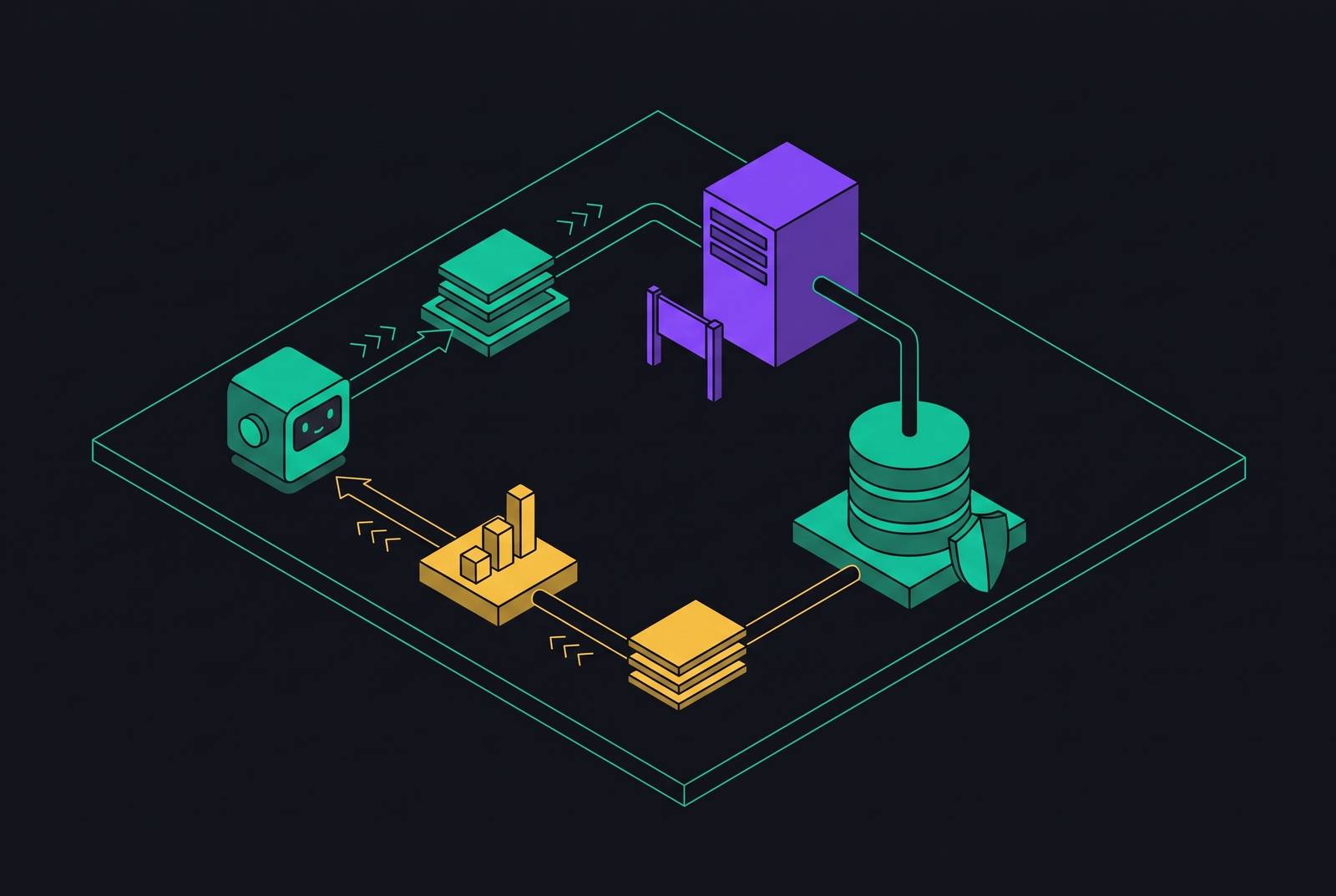
AI agents should access Supabase analytics through an MCP endpoint backed by governed, pre-calculated metrics. Row-level access controls limit which data can be accessed, while the governed data layer keeps definitions consistent and analytical workloads off the production query path.
What MCP is and why it matters for agent-to-data requests on Supabase
MCP is an open protocol that replaces one-off integrations between language models and external tools with a standardized communication layer. The model has three parts: the agent, the MCP server, and the database. The server is an intermediary. On Supabase, it has its own authentication, rate limits, and logging pipeline, separate from the application’s user-traffic path. That separation creates a place to govern requests, but it does not by itself isolate the database resources those requests consume.
Supabase Select 2026 formalized a distinction within this model. The official Supabase MCP server serves developer and agent tooling, while an application’s own MCP server, built on @supabase/server, serves user-facing agent interactions. Choosing between them establishes the context for later decisions about tools, identity, and permissions.
Stage 1: How the agent discovers what tools are available before any query runs
The lifecycle begins before the user asks a question. When the MCP Host connects to available servers, it inventories their capabilities. At initialization, servers share tool names and natural-language descriptions, which become part of the agent’s context. The agent can then match an incoming request to a tool without requiring the user to name it explicitly.
Supabase’s plugin for AI coding agents bundles the MCP server with agent skills, which are procedural knowledge documents. Discovery loads guidance as well as tool names. That guidance covers query optimization patterns, RLS awareness, and connection management so the agent has Supabase-specific instructions for using the tools it can call. The inventory establishes what the agent can call, while the skills help shape how it uses those tools.
For analytics, a missing tool can determine the entire route. If pre-calculated metric datasets are not exposed as named tools, the available interface leads the agent to raw table queries because governed alternatives never entered its context. It is a consequence of the available interface, and later reasoning cannot select a governed metric tool that discovery did not supply. What gets loaded at initialization governs the session that follows.
Stage 2: How the agent resolves an analytics intent into a specific tool call
Once discovery is complete, the agent must translate a request such as “what is our churn this month?” into a specific tool call. The central difficulty is identifying which business definition the word churn denotes. If the available tools expose only raw schema, the agent must infer how the business calculates the metric. Choosing a tool then depends on data governance as well as the language model.
A semantic layer changes the nature of this decision. When metric definitions are pre-modeled and exposed as named, queryable tools, intent resolution becomes a lookup. Churn resolves to a governed definition instead of a calculation assembled from the agent’s reading of tables. Knowing when to prefer a view over a raw table query does not establish what the business means by churn.
The ScaleMCP paper frames tool selection as a retrieval architecture problem. It introduces dynamic MCP server discovery, an auto-synchronizing tool storage pipeline, and a Tool Document Weighted Average embedding strategy to improve tool selection. Retrieval and governance address different parts of correctness. Better retrieval helps the agent find a tool, while governed definitions align its answer with what the business intended to ask. Supabase’s bundled skills further shape the call through guidance on RLS, connection pooling, and views.
Stage 3: Authentication and permission enforcement before the query reaches the database
Before SQL reaches Postgres, the MCP server authenticates the caller and determines the connecting database role. This decision sets the session’s permission boundary. Database checks still enforce access when queries run, but the role establishes which operations can pass those checks. Authentication therefore fixes the scope within which the agent’s later choices operate.
The two authentication flows have different blast radii. Agent-initiated infrastructure changes, including provisioning tables and modifying RLS policies, authenticate with project API keys under scoped, role-based access control. This follows the model of a human developer using the CLI, with agent actions logged under a distinct identifier. When a user starts an interaction through an application’s MCP server, it authenticates as the signed-in user. The agent inherits that user’s RLS policies and sees only what the user is permitted to see.
Supabase Select 2026 showcased Scoped Personal Access Tokens, generally available since October 6, 2026. These limit tokens to specific organizations, projects, and permissions before a session begins. Enterprise-Managed Auth for MCP, generally available on Team and Enterprise plans with Okta SSO, binds each token to the identity provider member who signs in. That binding keeps tokens from being shared across agent sessions.
The service role key creates a separate risk. It bypasses all RLS policies and grants unrestricted database access, making it appropriate for administrative tasks but not agent sessions interacting with user data. An anon key with explicit RLS policies supports access for users through the application. RLS governs SELECT, INSERT, UPDATE, and DELETE, but does not constrain DDL commands such as DROP TABLE or ALTER TABLE. The connecting role itself must have limits on those operations.
Human confirmation provides a further, narrower gate. MCP Elicitations, on by default as of Supabase Select 2026, require confirmation before an agent creates a paid project, creates a branch, or runs SQL that could delete data. This does not replace role restrictions.
Stage 4: What happens when the query actually executes against Postgres
Execution brings the earlier decisions into contact with the database. The tool chosen, the query built, the connecting role, and the runtime constraints now shape what happens in the database. A governed tool and a constrained role protect different things. The former controls the meaning of the requested calculation, while the latter limits the data and operations available to perform it. Neither removes the resource demands of the query.
For an MCP path implemented through Edge Functions, the runtime imposes hard limits. Each request has 2 seconds of CPU time and a 150-second idle timeout, with separate wall-clock limits of 150 s on Free plans and 400 s on paid plans. These limits constrain distinct aspects of the runtime. Analytical work involving large aggregations, cohort calculations, or multiple datasets makes synchronous execution a poor assumption and requires an async offload path from the start. Even when the request is offloaded, analytical work can still run on production Postgres.
Supabase Select 2026 introduced Database Connections visibility in the dashboard. Operators can see sessions holding connections, long-running queries, blocked queries, and lock holders, then cancel a query or terminate a connection. This makes intervention possible when agent queries misbehave. It also exposes the operational consequence of allowing unpredictable analytical requests onto a database serving live users.
Execution is also where prompt injection becomes acute. Malicious text in a database row, such as a support ticket or user comment, can influence the agent’s query construction after authentication has passed. Content sanitization is therefore required at both the tool-call layer and the initial input boundary. The PostgREST MCP server enforces RLS during execution even when injected content influences the agent. The database role has the final say over which rows can be accessed, regardless of the agent’s reasoning.
How can AI agents query Supabase analytics without touching production tables?
Direct execution against production Postgres fits operational queries and developer tooling, but analytics introduces a different workload. Analytical requests are read-heavy, aggregation-heavy, and unpredictably expensive in CPU time. They compete with live user traffic for database resources and the connection pool. Routing raw analytics through a separate MCP interface retains the structural mismatch of shared production database compute.
The risks extend beyond contention for resources. Without governed definitions, two agents, or the same agent on different occasions, can calculate different ARR or churn figures from the same raw schema. Read-only permissions also do not prevent private data from leaving through response text when untrusted content influences what an agent summarizes or relays. Meanwhile, unbounded analytical queries run until completion or timeout without query-cost governance. Performance, accuracy, safety, and cost therefore require more than a restricted SQL role.
Supabase Pipelines offers a way to separate analytical execution from production. In public alpha as of July 2026 on Pro, Team, and Enterprise plans, it streams Postgres data in near real time to BigQuery, ClickHouse, DuckLake, or Snowflake. The MCP server can route analytical calls to that downstream destination instead. This relocates the workload away from production Postgres. It does not, on its own, define the business metrics that agents should request.
A governed data layer fills in the metric definitions. Metrics are pre-calculated into Parquet datasets queryable via DuckDB, and agents consume the pre-modeled results through an MCP endpoint. With this approach, agents can use consistent metrics and see less raw data without having to build calculations against raw production tables. For interactions with users where row access is controlled, the application MCP server lets the agent connect as the signed-in user. For analytics, that access control belongs in a layered design with governed metrics and execution away from production.
Stage 5: Result delivery and what makes a result trustworthy once it leaves the server
The MCP server returns a result that the agent incorporates into its response. Delivery does not establish that the result is correct. The agent has no independent way to know whether the number came from the right dataset, used the business’s metric definition, or was calculated correctly. Those properties were determined before the result left the server.
Trust therefore depends on the upstream chain. The producing tool must execute the intended metric definition, and that definition must be grounded in the governance layer that pre-modeled it. A well-written response cannot fix a broken link in that chain. Successful execution alone leaves unresolved whether a raw-table calculation used the business’s intended definition or the agent’s interpretation of it.
Operational signals can expose problems in that chain. Supabase Select 2026 introduced the query_logs MCP tool, which lets an agent query project logs directly through SQL. The Supabase agent skill also points to a living document of health, security, performance, and resource signals. Together, these support anomaly detection in both the output pipeline and the application. They provide operational observations, while metric definitions remain necessary.
Supabase dashboard agent prompts add scheduled, read-only health and security checks through the MCP server. This places scheduled checks where operators work, reducing reliance on remembered inspections. As agent coordination becomes multi-hop, weaknesses in the producing pipeline can propagate into subsequent decisions. A governed data layer provides a consistent foundation across those handoffs, while monitoring helps identify failures around it.
What teams building on Supabase should instrument before giving agents analytics access
For user-facing agent sessions, teams should use anon keys with explicit RLS policies and connecting roles that never hold DROP, ALTER, or TRUNCATE privileges. Scoped Personal Access Tokens should narrow token access, and eligible Team and Enterprise deployments should enable Enterprise-Managed Auth. Each control addresses a different permission boundary. None substitutes for the others.
Observability is a precondition for granting write access. Teams need separate agent identifiers in audit logs, Database Connections visibility, and alerts when resource usage differs from what they expect. Without those instruments, they cannot adequately monitor the behavior they have authorized.
CAC, LTV, churn, ARR, and gross margin should exist as governed, pre-modeled artifacts before agents receive access to them. Calculating these from raw schema leaves results neither auditable nor reproducible, regardless of the surrounding authentication controls. The governed data layer is therefore a precondition.
For any result, the team should be able to identify the connecting role, the producing tool, the metric definition used, and whether any of them changed since the previous result. These questions connect the delivered answer to its origin. If any answer is unknown, the pipeline is not ready for analytics agents.